
The Ant Goes Marching
June the hungry ant is traveling across the surface of a cylinder to reach her dinner. How fast can she get there?

Welcome to Fiddler on the Proof, the spiritual successor to FiveThirtyEight’s The Riddler column.
Every Friday morning, I present mathematical puzzles intended to challenge and delight you. Most can be solved with careful thought, pencil and paper, and the aid of a calculator. The “Extra Credit” is where the analysis typically gets hairy, or where you might turn to a computer for assistance.
I’ll also give a shoutout to 🎻 one lucky winner 🎻 of the previous week’s puzzle, chosen randomly from among those who submit their solution before 11:59 p.m. the Monday after puzzles are released. I’ll do my best to read through all the submissions and give additional shoutouts to creative approaches or awesome visualizations, the latter of which could receive 🎬 Best Picture Awards 🎬.
This Week’s Fiddler
This week’s puzzle is a very special collaboration between Fiddler on the Proof and Science News, where four math puzzles that are related were posted earlier this morning. The third and fourth among these are also appearing here as this week’s Fiddler and Extra Credit. Now—on to those puzzles!
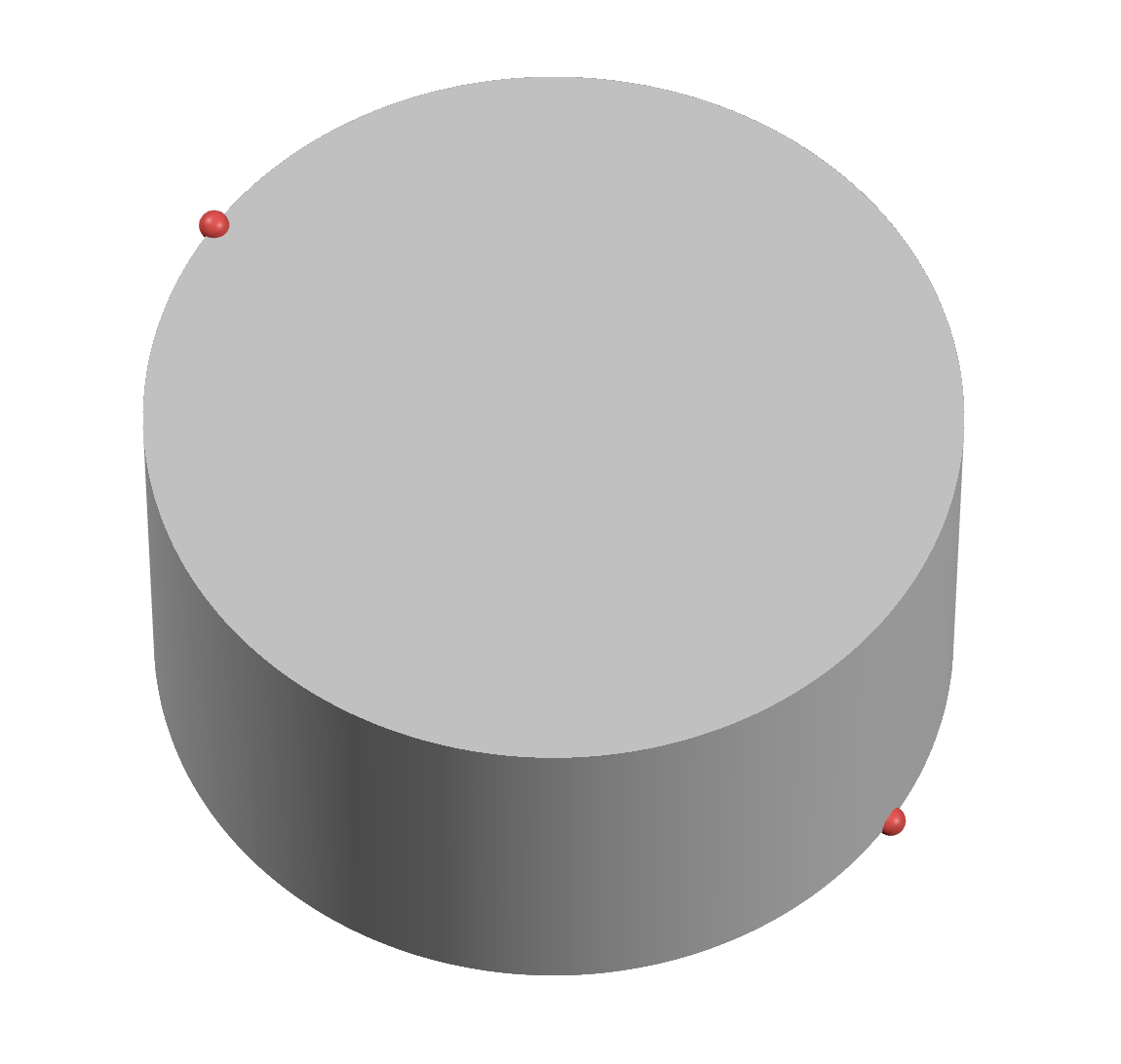
June the ant is on a cylinder. More specifically, she is on the edge of one of the cylinder’s two circular faces. Her dinner is on the edge of the opposite circular face, and all the way around on the other side of that face. The radius of the cylinder is 2 meters and its height is 2 meters.
Your job is to help June find the shortest path along the surface of the cylinder so that she can chow down as quickly as possible. What’s the length of this shortest path?
This Week’s Extra Credit
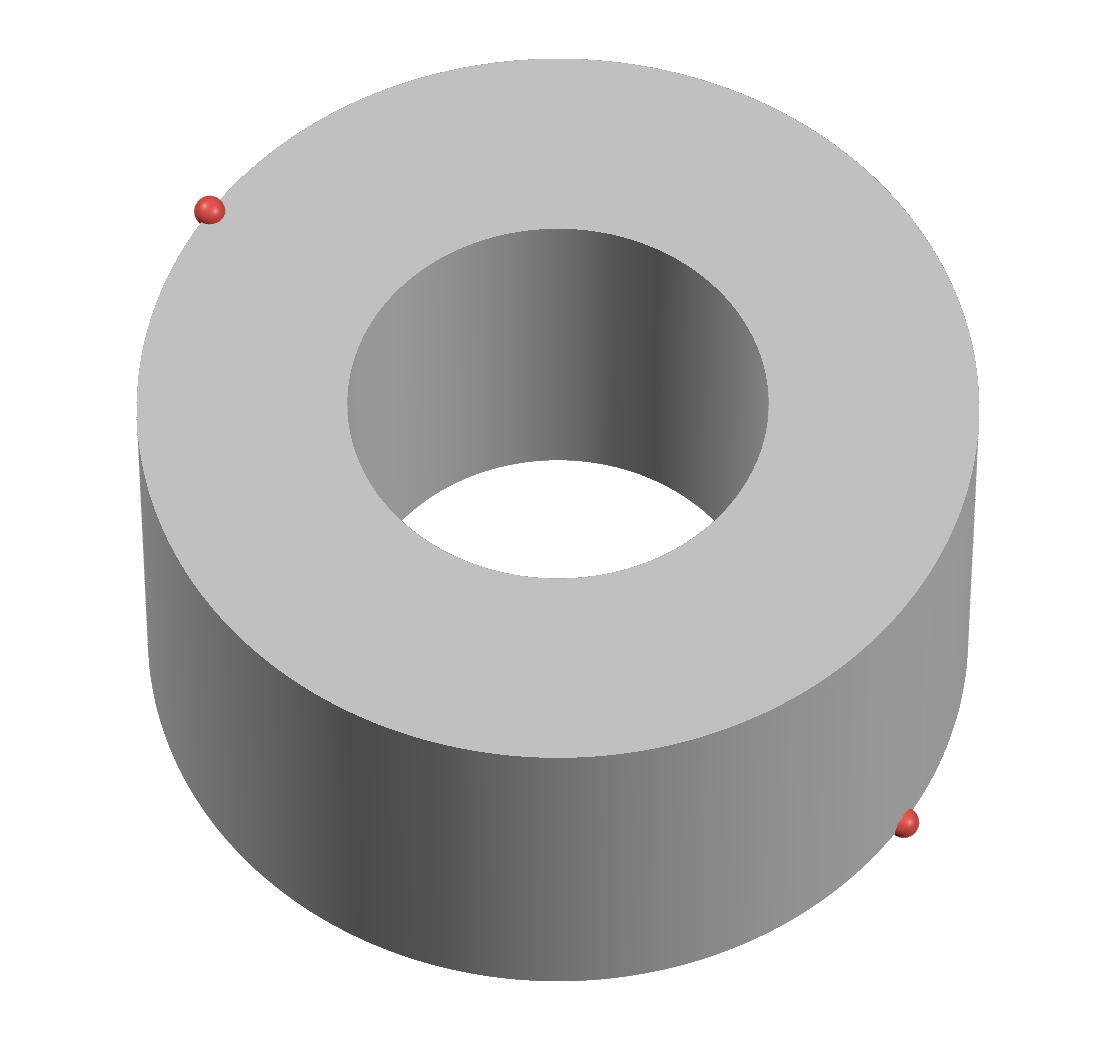
Now, June is on a hollowed-out cylinder, also known as a “cylindrical shell.” The shell’s outer radius is 2 meters and its inner radius is 1 meter. The shell is 2 meters tall. June is on the outer edge of one of the cylinder’s two flat faces. Her dinner is on the opposite face, and all the way around on the other end of that face.
Once again, your job is to help June find the shortest path along the surface of the shell so that she can chow down as quickly as possible. What’s the length of this shortest path?
Making the ⌊Rounds⌉
There’s so much more puzzling goodness out there, I’d be remiss if I didn’t share some of it here. This week, I’m sharing that I’ll be speaking to a group of high school students at the American Regions Math League later this month. To prepare, I snuck a peak at last year’s problems from the annual competition.
ARML’s crown jewel every year is its Power Round. Last year’s is titled “The Bases are Loaded!,” and it concerns integer partitions in which the parts are numbers whose only prime factors are 2 and/or 3. After some preliminary definitions, it gets rolling with a mix of computations and proofs. Enjoy!
After this year’s ARML, I’ll report back here with one or two of its latest and greatest problems.
Want to Submit a Puzzle Idea?
Then do it! Your puzzle could be the highlight of everyone’s weekend. If you have a puzzle idea, shoot me an email. I love it when ideas also come with solutions, but that’s not a requirement.
Standings
I’m tracking submissions from paid subscribers and compiling a leaderboard, which I’ll reset every quarter. All correct solutions to Fiddlers and Extra Credits are worth 1 point each. Solutions should be sent prior to 11:59 p.m. the Monday after puzzles are released. At the end of each quarter, I’ll 👑 crown 👑 the finest of Fiddlers. If you think you see a mistake in the standings, kindly let me know.
Last Week’s Fiddler
Congratulations to the (randomly selected) winner from last week: 🎻 Sean Garagan 🎻 from Halifax, Nova Scotia, Canada. I received 55 timely submissions, of which 39 were correct—good for a 71 percent solve rate.
Last week, I was playing hide-and-seek with my nephew. I started at point O, whereas my nephew could hide at point A, B, or C. I could walk from O to A in 2 minutes, from O to B in 3 minutes, from O to C in 4 minutes, and from B to C in 5 minutes. To get from A to B or from A to C, I had to pass through O.
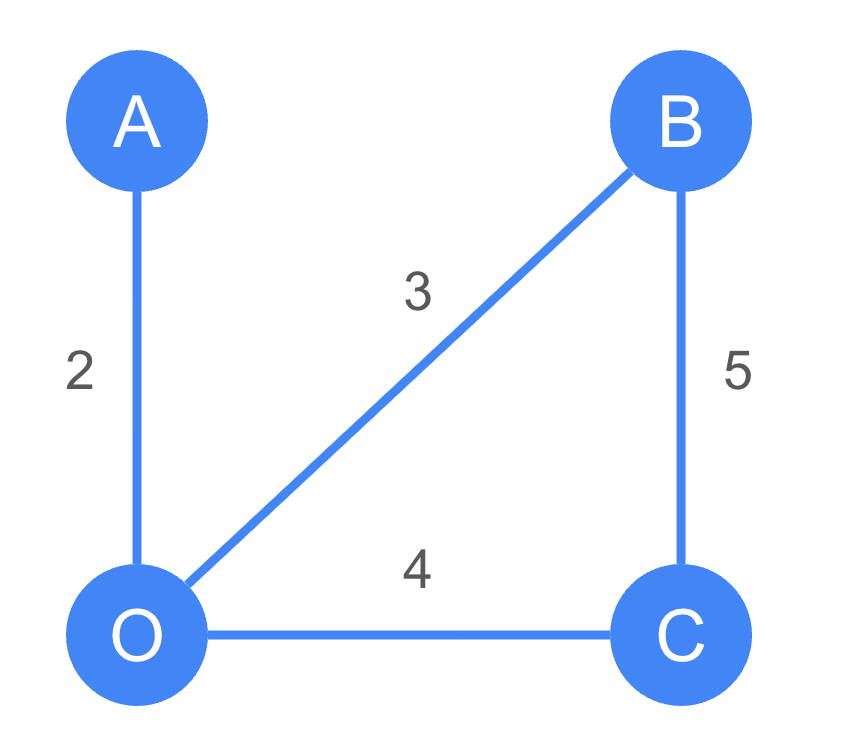
My goal was to minimize the time it took to find my nephew, no matter how clever his strategy might have been. What was this optimal time?
In the words of Peter Exterkate, “This [was] an extremely poorly worded puzzle.” This was through no fault of the puzzle’s submitter, but rather my own. Therefore, I generously allowed for more than one interpretation.
The first interpretation was that of a “worst-case scenario.” What was the shortest path that guaranteed I’d look in all three hiding spots? There were six possible orders to consider:
Search A, then B, then C. This path took 2 + 2 + 3 + 5 = 12 minutes.
Search A, then C, then B. This path took 2 + 2 + 4 + 5 = 13 minutes.
Search B, then A, then C. This path took 3 + 3 + 2 +2 + 4 = 14 minutes.
Search B, then C, then A. This path took 3 + 5 + 4 + 2 = 14 minutes.
Search C, then A, then B. This path took 4 + 4 + 2 + 2 + 3 = 15 minutes.
Search C, then B, then A. This path took 4 + 5 + 3 + 2 = 14 minutes.
Thus, the most efficient path was to search A, then B, then C for a total of 12 minutes. This was a reasonable answer to this puzzle as I presented it. Also, since this was the worst-case scenario, I didn’t accept any answers greater than 12 minutes.
A second (and more challenging) interpretation was to minimize the average time it took to find my nephew, regardless of his hiding strategy. I still had the six distinct searching strategies listed above, whereas my nephew had three distinct hiding strategies (hide at A, hide at B, and hide at C). Thus, our game of hide-and-seek had the following payoff matrix:
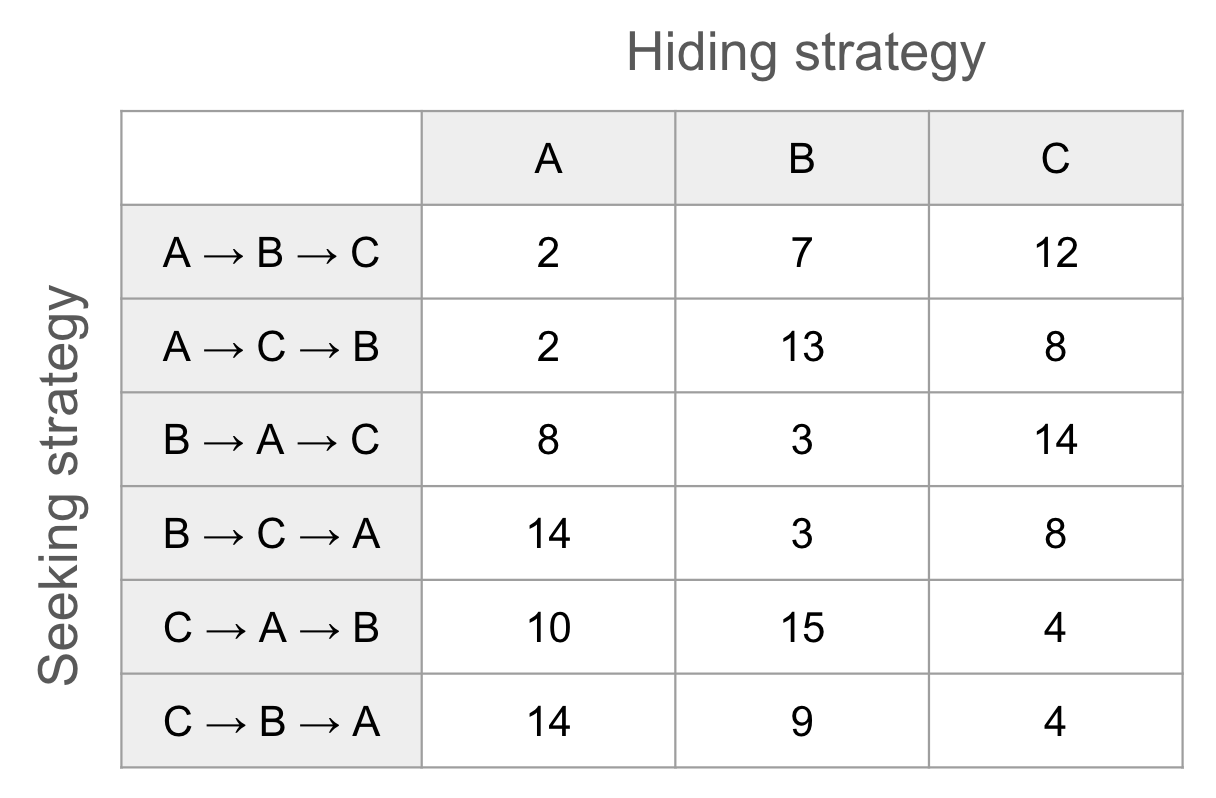
To understand this table, consider the last row, where my searching strategy was C, then B, then A. If my nephew was hiding at C, I found him in 4 minutes; if he was hiding at B, I found him in 9 minutes; and if he was hiding at A, I found him in 14 minutes.
The question then became how I might mix strategies across the six rows so that the average seeking time across the three columns was minimized. If I mixed all six strategies, then if my nephew was hiding at A, I found him in an average of 8 minutes and 20 seconds. And the same went for B and C. Picking one of the six strategies at random was a fairly decent strategy. But it was possible to do better!
Instead of mixing all six strategies, suppose I mixed only two, each with a 50 percent chance. For example, suppose I equally mixed the strategies “A → B → C” and “C → A → B,” the first and fifth rows in the table above.
If my nephew was hiding at A, then the expected time to find him was (2+10)/2, or 6 minutes.
If my nephew was hiding at B, then the expected time to find him was (7+15)/2, or 11 minutes.
If my nephew was hiding at C, then the expected time to find him was (12+4)/2, or 8 minutes.
The greatest average among these was 11 minutes, when my nephew was hiding at B. So if I mixed those two strategies, it was possible for my nephew to adopt a strategy where it took me 11 minutes on average. Not great.
If you did a similar analysis for the various ways to equally mix two strategies, you got the resulting table:
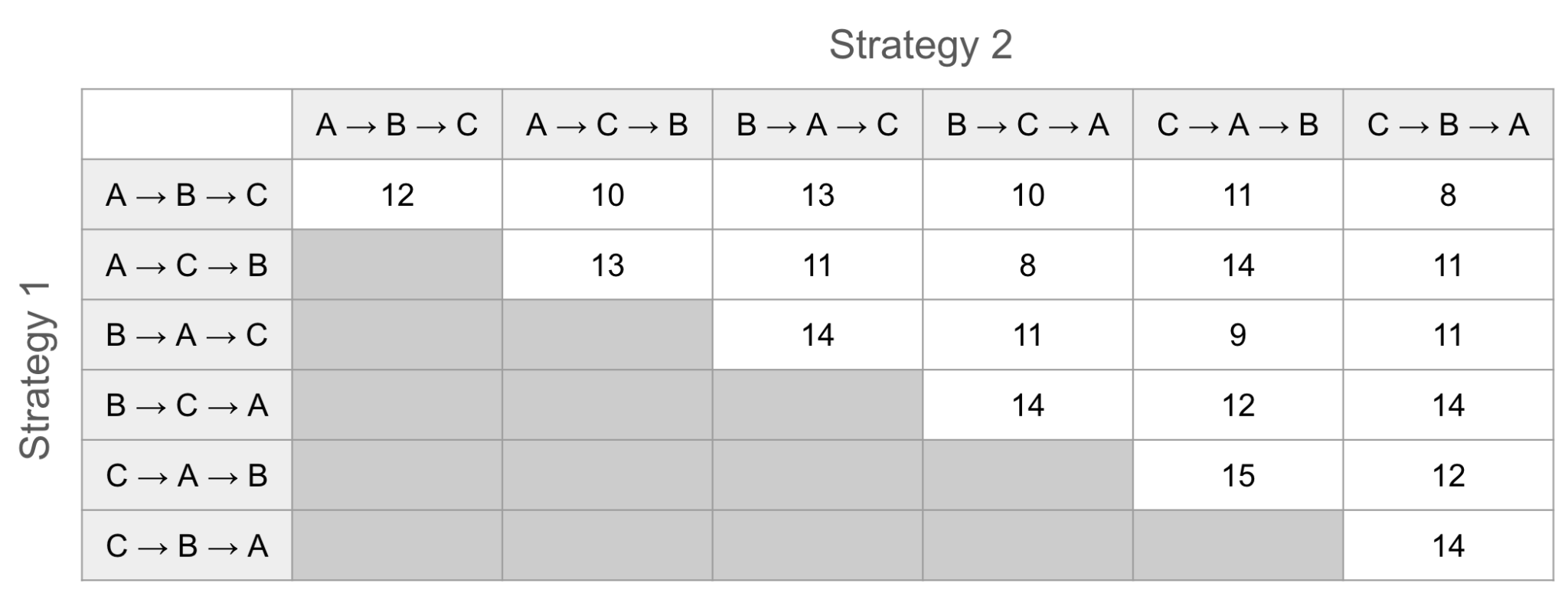
There were two minima in this table. First, if I equally mixed “A → B → C” and “C → B → A,” then it took an average of 8 minutes to find my nephew, no matter where he was hiding. Alternatively, if I equally mixed “A → C → B” and “B → C → A,” then it again took an average of 8 minutes to find my nephew, no matter where he was hiding.
With a little work, you could convince yourself that other mixings of strategies could never result in a maximum average that was greater than 8 minutes. Solver 🎬 Michael Schubmehl 🎬 did this by plotting the regimes where each search strategy was optimal across the varying hiding strategies.
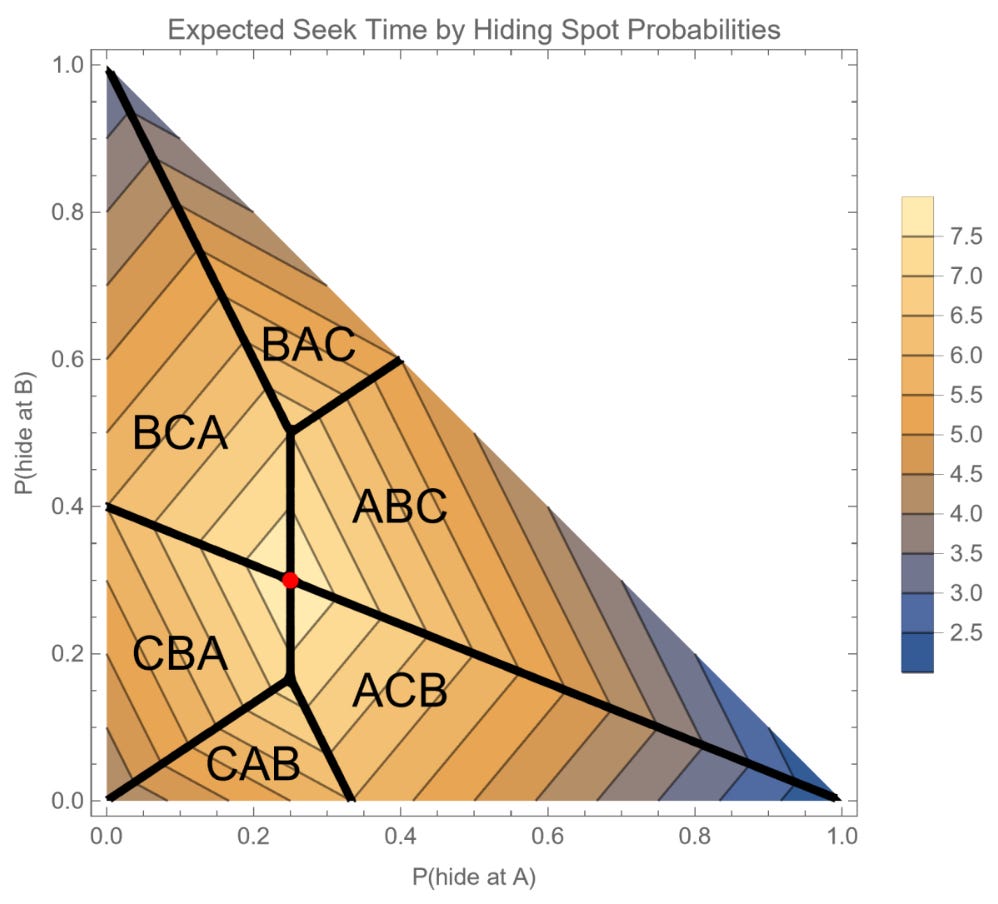
In the end, if I wanted to minimize the average time to find my nephew, this minimum average was 8 minutes.
Other answers submitted by readers made specific assumptions about where my nephew would hide (e.g., he was equally likely to hide in all three locations)—assumptions that were not in the spirit of the puzzle. And so, in the end, I only accepted answers of 8 and 12 minutes.
Last Week’s Extra Credit
Congratulations to the (randomly selected) winner from last week: 🎻 Srihari Narayanan 🎻 from Hayward, California. I received 20 timely submissions, of which 8 were correct—good for a 40 percent solve rate. (This was a tough one, and I’m sure I’ll receive at least one or two objections to the following solution.)
My nephew could no longer hide at C, and was instead limited to A and B. But this time, he had a teleporter that could instantaneously transport him from A to B or from B to A. He could use the teleporter as many times as he wanted. However, he couldn’t react to my approach, and he instead had to plan out his transport schedule ahead of time. That said, he did know the precise time when the game started.
My goal was to minimize the average time it took to find him, no matter how clever his strategy might have been. What was this optimal time?
