
Can You Drink the “Random-ade”?
I’m preparing a mixture of “random-ade” by combining random amounts of ingredients, running out of them, and replacing them with new random amounts. How much can I expect to make on average?

Welcome to Fiddler on the Proof, the spiritual successor to FiveThirtyEight’s The Riddler column.
Every Friday morning, I present mathematical puzzles intended to challenge and delight you. Most can be solved with careful thought, pencil and paper, and the aid of a calculator. The “Extra Credit” is where the analysis typically gets hairy, or where you might turn to a computer for assistance.
I’ll also give a shoutout to 🎻 one lucky winner 🎻 of the previous week’s puzzle, chosen randomly from among those who submit their solution before 11:59 p.m. the Monday after puzzles are released. I’ll do my best to read through all the submissions and give additional shoutouts to creative approaches or awesome visualizations, the latter of which could receive 🎬 Best Picture Awards 🎬.
This Week’s Fiddler
I’m preparing a mixture of “random-ade” using a large, empty pitcher and two 12-ounce glasses.
First, I fill one glass with some amount of lemon juice chosen randomly and uniformly between 0 and 12 ounces. I fill the other glass with some amount of water, also chosen randomly and uniformly between 0 and 12 ounces. Next, I pour an equal amount from each glass into the pitcher until one of the glasses is empty.
At this point, I refill that empty glass with yet another random amount of the same liquid it previously contained. Once again, I pour an equal amount from each glass into the pitcher until one of the glasses is empty.
On average, how much random-ade can I expect to prepare? (Note that all three random amounts in this problem are chosen independently of each other.)
This Week’s Extra Credit
Once again I’m preparing random-ade, but this time I have three 12-ounce glasses.
I fill the first glass with a random amount of lemon juice, the second glass with a random amount of lime juice, and the third glass with a random amount of water. As before, each amount is chosen uniformly between 0 and 12 ounces, and all amounts are independent. Next, I pour an equal amount from each glass into the pitcher until one of the glasses is empty.
At this point, I refill that empty glass with yet another random amount of the same liquid it previously contained. Once again, I pour an equal amount from each glass into the pitcher until one of the glasses is empty.
Then I refill that now-empty glass with yet another random amount of the same liquid it previously contained. Again, I pour an equal amount from each glass into the pitcher until one of the glasses is empty.
On average, how much random-ade can I expect to prepare?
Making the ⌊Rounds⌉
There’s so much more puzzling goodness out there, I’d be remiss if I didn’t share some of it here. This week, I’m sharing IBM’s “Ponder This” puzzles. (Last month, some readers noted that IBM had posed a problem that was thematically similar to the Fiddler from two weeks ago.)
This month’s puzzle is called “The Powers of a Binary Matrix.” If I’m reading it correctly, it’s asking you to find permutation matrices that result in the identity matrix only when taken to maximally high powers. It’s a neat problem, but I think it could be grounded a little more. Here’s my attempt at doing so:
Imagine you shuffle a deck of cards exactly the same way every time. In the worst-case scenario, what’s the maximum number of shuffles needed to return to the original ordering of the deck? What if the deck has 10 cards? 50 cards? A million cards?
Want to Submit a Puzzle Idea?
Then do it! Your puzzle could be the highlight of everyone’s weekend. If you have a puzzle idea, shoot me an email. I love it when ideas also come with solutions, but that’s not a requirement.
Standings
I’m tracking submissions from paid subscribers and compiling a leaderboard, which I’ll reset every quarter. All correct solutions to Fiddlers and Extra Credits are worth 1 point each. Solutions should be sent prior to 11:59 p.m. the Monday after puzzles are released. At the end of each quarter, I’ll 👑 crown 👑 the finest of Fiddlers. If you think you see a mistake in the standings, kindly let me know.
Last Week’s Fiddler
Congratulations to the (randomly selected) winner from last week: 🎻 Fred 🎻 from Kansas City. I received 72 timely submissions, of which 61 were correct—good for an 85 percent solve rate.
Last week, a frog was hopping around a chessboard, always from the center of one square to the center of another square. Each square had side length 1, but the board itself was not necessarily 8-by-8. Instead, it was N-by-N, where N was some large whole number.
Every jump the frog made was the same distance, which we called L. The frog wanted to make four jumps such that:
After the fourth jump, the frog returned to its starting square.
The frog visited a total of four distinct squares along the way, including the square on which it started (and also stopped).
The path the frog took was not a square loop.
The frog was never on a square that was diagonal (i.e., a bishop’s move away) or horizontal/vertical (i.e., a rook’s move away) from the starting square.
What was the smallest jumping distance L for which this was possible?
First off, I had neglected to specify the rook condition in that last bullet point when I originally posted the puzzle. Without that condition, the shortest distance the frog had to hop was √5, much like a knight in chess. Here was a four-jump path the frog could have taken:
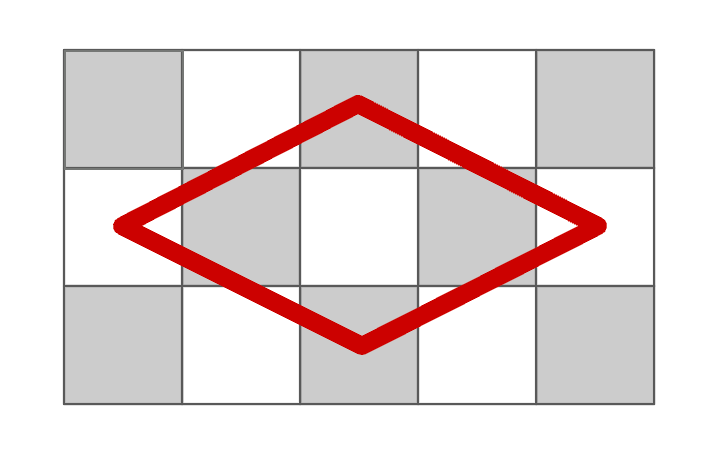
But notice that no matter which square in this path the frog started from, two moves later it was on a square that was a rook’s move away. So with the rook condition, the puzzle was definitely trickier. Nevertheless, because of my erratum, I accepted answers of √5 that were submitted on May 1.
Now, instead of moving 2 squares in one direction and 1 square in a perpendicular direction (like a knight), suppose the frog jumped a squares in one direction and b squares in a perpendicular direction. If the frog started at the origin, then some possible four-jump paths to consider were:
(0, 0) → (a, b) → (2a, 0) → (a, -b) → (0, 0). However, like the path illustrated above, (2a, 0) was a rook’s move from (0, 0).
(0, 0) → (a, b) → (a+b, a+b) → (b, a) → (0, 0). However, (a+b, a+b) was a bishop’s move from (0, 0).
(0, 0) → (a, b) → (a−b, a+b) → (-b, a) → (0, 0). However, the shape of this loop was a square.
These were all dead ends, which meant something was up. And that something was that the frog had to be able to make two equally distant jumps in two substantially different directions. In other words, the frog had to be able to jump a squares in one direction and b squares in a perpendicular direction, or c squares in one direction and d squares in a perpendicular direction. Then a plausible path would be:
(0, 0) → (a, b) → (a+c, b+d) → (c, d) → (0, 0)
By the Pythagorean theorem, a jump that was a and then b in perpendicular directions had length √(a2+b2), while a jump that was c and then d in perpendicular directions had length √(c2+d2). For these lengths to be equal, you needed √(a2+b2) = √(c2+d2), or a2+b2 = c2+d2. In other words, you were looking for a number—the square of the jump length, to be precise—that could be written as the sum of two squares two different ways.
The smallest such number is 25, which equals both 42+32 and 52+02. However, paths with a jump length of √25 = 5 would have passed through a point like (5, 0), which was a rook’s move from the origin. Thus, we were looking for a number that could be written as the sum of two squares two different ways, such that neither square was 0.
The next candidate was 50, which equals both 72+12 and 52+52. However, paths with a jump length of √50 would have passed through a point like (5, 5), which was a bishop’s move from the origin. So in addition to neither square being zero, the two squares also couldn’t be equal.
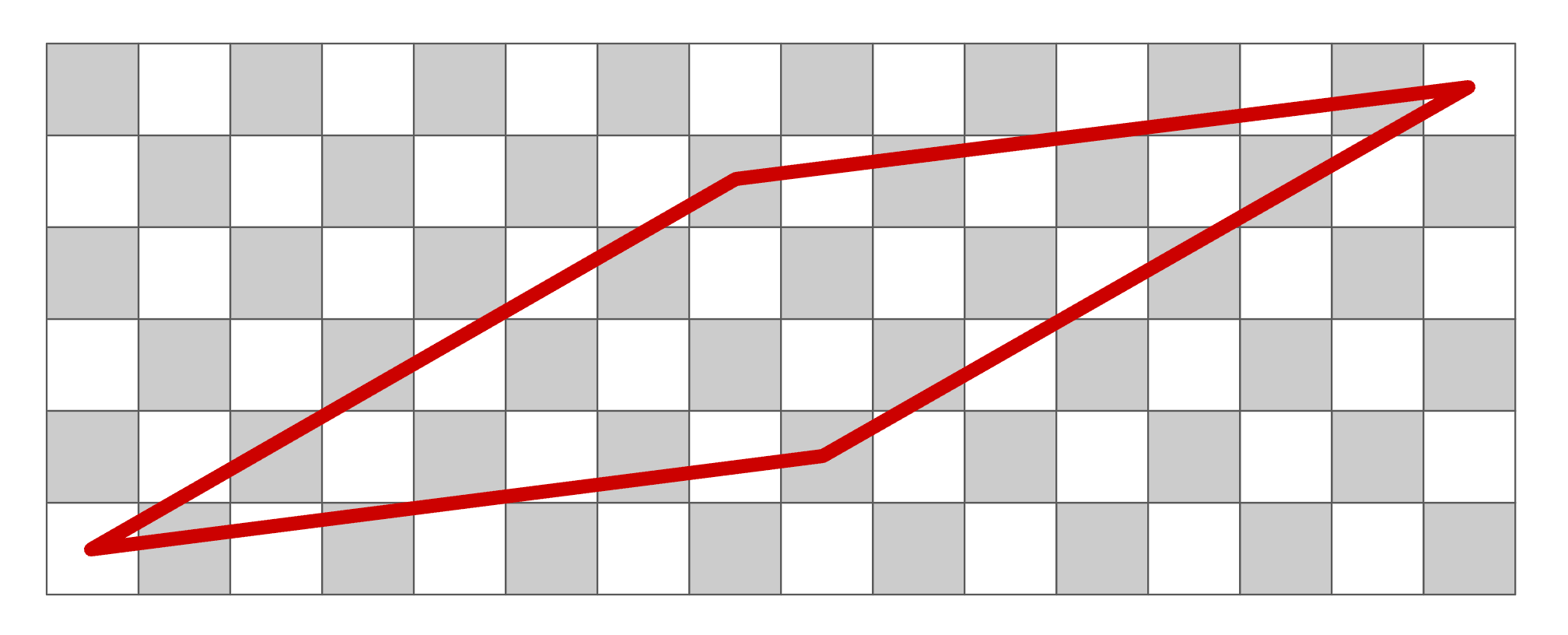
And so, we came to the next candidate, 65, which equals both 82+12 and 72+42. Plugging these values into the path above gave one such valid loop:
(0, 0) → (8, 1) → (15, 5) → (7, 4) → (0, 0)
This path was the rhombus shown below, and there were also other similar loops you could have made with the same jumping distance. Thus, the smallest jumping distance L was √65.
Last Week’s Extra Credit
Congratulations to the (randomly selected) winner from last week: 🎻 Eli Wolfhagen 🎻 from Brooklyn, New York. I received 45 timely submissions, of which 34 were correct—good for a 76 percent solve rate.
The frog was jumping around the board with the same minimum distance L we had just found: √65.
But this time, the frog also wanted to be able to hop to every location on the chessboard. What was the minimum value of N for which this was possible?
