

Welcome to Fiddler on the Proof, the spiritual successor to FiveThirtyEight’s The Riddler column.
Every Friday morning, I present mathematical puzzles intended to challenge and delight you. Most can be solved with careful thought, pencil and paper, and the aid of a calculator. The “Extra Credit” is where the analysis typically gets hairy, or where you might turn to a computer for assistance.
I’ll also give a shoutout to 🎻 one lucky winner 🎻 of the previous week’s puzzle, chosen randomly from among those who submit their solution before 11:59 p.m. the Monday after puzzles are released. I’ll do my best to read through all the submissions and give additional shoutouts to creative approaches or awesome visualizations, the latter of which could receive 🎬 Best Picture Awards 🎬.
This Week’s Fiddler
For her photography show, Frederica Fiddleria attaches a light to a point on the circumference of a circular wheel with a radius of 1 meter. She points a camera at the wheel and, during a single long exposure, rolls the wheel for one revolution along the ground.
When she develops the film, she is curious about the path the light took as the wheel rolled. What is the length of this path?
This Week’s Extra Credit
For her next show, Frederica wants to mix things up. Instead of placing the light on the circumference of the wheel, she will pick a random point inside the circle. (Before you ask, let me clarify what “random” means here: Any two regions with the same area are equally likely to contain the point.)
As before, she will roll the wheel for one revolution along the ground and capture the motion with a single long exposure on her camera. On average, what can she expect the length of the path to be?
Making the ⌊Rounds⌉
There’s so much more puzzling goodness out there, I’d be remiss if I didn’t share some of it here. This week, I’m sharing an introductory lesson on machine learning and neural networks for high school students that I’ve been developing over at Amplify. Any and all feedback (especially from current or former educators) is greatly appreciated!
The ask: Start by opening this survey and answering a few questions about your teaching experience and views on AI. The survey will then link you to the lesson. After spending about 15 minutes reviewing it, return to the survey to complete the remaining questions about the lesson and what would help you feel prepared to teach it.
And if you’re curious about the lesson but aren’t sure if you want to complete the survey, you can check it out here.
Want to Submit a Puzzle Idea?
Then do it! Your puzzle could be the highlight of everyone’s weekend. If you have a puzzle idea, shoot me an email. I love it when ideas also come with solutions, but that’s not a requirement.
Standings
I’m tracking submissions from paid subscribers and compiling a leaderboard, which I’ll reset every quarter. All correct solutions to Fiddlers and Extra Credits are worth 1 point each. Solutions should be sent prior to 11:59 p.m. the Monday after puzzles are released. At the end of each quarter, I’ll 👑 crown 👑 the finest of Fiddlers. If you think you see a mistake in the standings, kindly let me know.
Last Week’s Fiddler
Congratulations to the (randomly selected) winner from last week: 🎻 Jeffrey Ling 🎻 from San Francisco, California. I received 15 timely submissions, of which 9 were correct—good for a 60 percent solve rate.
Yes, last week’s Fiddler was a little different. It was styled after the MIT Mystery Hunt (although, as you’ll see, there was still plenty of math involved) and ran in a game-centric special edition of the Financial Times. Here was the puzzle:
Camp Algebra
Camp Algebra held a competition in which campers were split into two teams: the Aces and the Ciphers. Various members of these teams competed in a triathlon of chess, basketball, and baseball. The results are shown below. To commemorate the event, the camp counselors designed a cuboidal trophy with dimensions that cleverly related to the results of the three events. Then, being Camp Algebra after all, they computed the square of the shortest path along the trophy’s surface from one corner to the opposite corner. After decoding that number, namely, what camp mascot did they carve into the trophy?
Chess
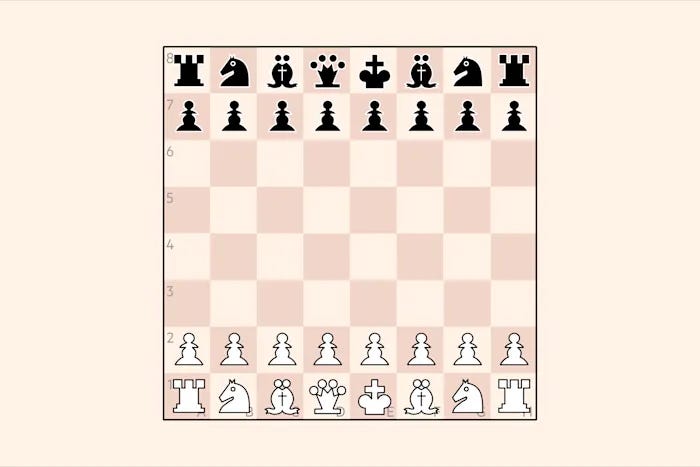
Occupatus, playing as white for the Aces, had Castor, playing as black for the Ciphers, on the ropes. But the industrious Castor clearly gave a dam. With what next move did Castor turn the tables?
Basketball
The Aces crushed the Ciphers in the second competition. While the box score showed all the players’ names in order, it neglected to tally the two teams’ scores bit by bit.
Statistics are minutes, rebounds, assists, steals, blocks, total field goals, 3-point field goals and free throws.
Baseball
In the final event, the Aces narrowly defeated the Ciphers, 5-4. But whatever did the scoreboard look like? Surely both line-ups had something to say about that.
