
Can You Win the World Cup?
Your team has made it to the semifinals. Should you go all out in your semifinal match, or should you reserve some energy for the finals (in the hopes you make it there)?

Welcome to Fiddler on the Proof, the spiritual successor to FiveThirtyEight’s The Riddler column.
Every Friday morning, I present mathematical puzzles intended to challenge and delight you. Most can be solved with careful thought, pencil and paper, and the aid of a calculator. The “Extra Credit” is where the analysis typically gets hairy, or where you might turn to a computer for assistance.
I’ll also give a shoutout to 🎻 one lucky winner 🎻 of the previous week’s puzzle, chosen randomly from among those who submit their solution before 11:59 p.m. the Monday after puzzles are released. I’ll do my best to read through all the submissions and give additional shoutouts to creative approaches or awesome visualizations, the latter of which could receive 🎬 Best Picture Awards 🎬.
Note: Due to personal travel, the next edition of Fiddler on the Proof will be coming out on July 31, 2026.
This Week’s Fiddler
Congratulations to Fiddler Nation for making it to the semifinals of the World Cup! All four teams that made it this far are equally matched in that they each possess the same total amount of “energy.” In advance of each semifinal game, teams must independently decide how much of their energy to allocate to the match; all remaining energy goes toward the finals. The team that spends more energy in any given game will win. The semifinals and finals occur so close in time that teams can’t recuperate any of their energy in between.
You’ve heard that the managers for the other three teams are abysmal and have no idea how to allocate their teams’ energy. Each of the other managers will independently pick a random percentage between 0 and 100 and allocate that portion of their team’s energy to the semifinal game; the rest of that team’s energy will go toward the final.
Since you’re the cleverest manager of the bunch, you can choose an optimal strategy that will maximize Fiddler Nation’s probability of winning the World Cup. What is this optimal probability?
This Week’s Extra Credit
As it turns out, I spoke too soon. Fiddler Nation has made it to the quarterfinals of the World Cup rather than the semifinals. My mistake. As before, teams must allocate the same total amount of energy across up to three matches.
The managers for the other seven teams remain abysmal. Each manager will independently pick a random percentage between 0 and 100 and allocate that amount of their team’s energy to the quarterfinal. If they win, they will allocate a random amount of their remaining energy to the semifinal. And if they win that, the rest of their team’s energy will go toward the final.
Fiddler Nation’s strategy must be drawn up in advance, with no specific knowledge of the other teams’ strategies beyond what I have already shared.
That said, as the cleverest manager of the bunch you can once again choose an optimal strategy that will maximize Fiddler Nation’s probability of winning the World Cup. What is this optimal probability?
Making the ⌊Rounds⌉
There’s so much more puzzling goodness out there, I’d be remiss if I didn’t share some of it here. This week, I’m sharing two puzzles from familiar sources:
July’s MoMath Monthly Mindbender asks you to draw 100 chords on a circle, with each chord generated by connecting two randomly selected points on the circumference. On average, how many intersections can you expect? This reminds me of a similar puzzle from my Riddler days…
July’s Ponder This from IBM has now apparently corrected its previous typos. If you’re in the mood for number theory and large numbers, this one’s for you!
Want to Submit a Puzzle Idea?
Then do it! Your puzzle could be the highlight of everyone’s weekend. If you have a puzzle idea, shoot me an email. I love it when ideas also come with solutions, but that’s not a requirement.
Standings
I’m tracking submissions from paid subscribers and compiling a leaderboard, which I’ll reset every quarter. All correct solutions to Fiddlers and Extra Credits are worth 1 point each. Solutions should be sent prior to 11:59 p.m. the Monday after puzzles are released. At the end of each quarter, I’ll 👑 crown 👑 the finest of Fiddlers. If you think you see a mistake in the standings, kindly let me know.
Last Week’s Fiddler
Congratulations to the (randomly selected) winner from last week: 🎻 Ed Moores 🎻 from London, United Kingdom. I received 57 timely submissions, of which 48 were correct—good for an 84 percent solve rate.
Last week, the Tour de Fiddler was back!
This time, you analyzed a model for a cyclist’s speed v as a function of their pedaling power P, their mass m, and the ground’s angle of inclination 𝜃: v = P/(m·sin𝜃+10). For the purposes of this puzzle, you didn’t have to worry about the units for power, mass, or speed. (These are typically given in Watts, kilograms, and kilometers per hour or miles per hour, respectively.)
In cycling, roads are marked with a gradient g, which is a hill’s slope, typically expressed as a percentage. For example, an incredibly steep 45-degree incline has a gradient of 1, or “100 percent.”
You were asked to consider the following two riders:
A “climber,” who had a power of 300 and a mass of 60
A “sprinter,” who had a power of 325 and a mass of 80
At what gradient would the climber and sprinter have cycled at the same speed?
According to the formula, the climber’s speed was 300/(60·sin𝜃+10), while the sprinter’s speed was 325/(80·sin𝜃+10). Here was a graph of these two functions when 𝜃 was measured in degrees:
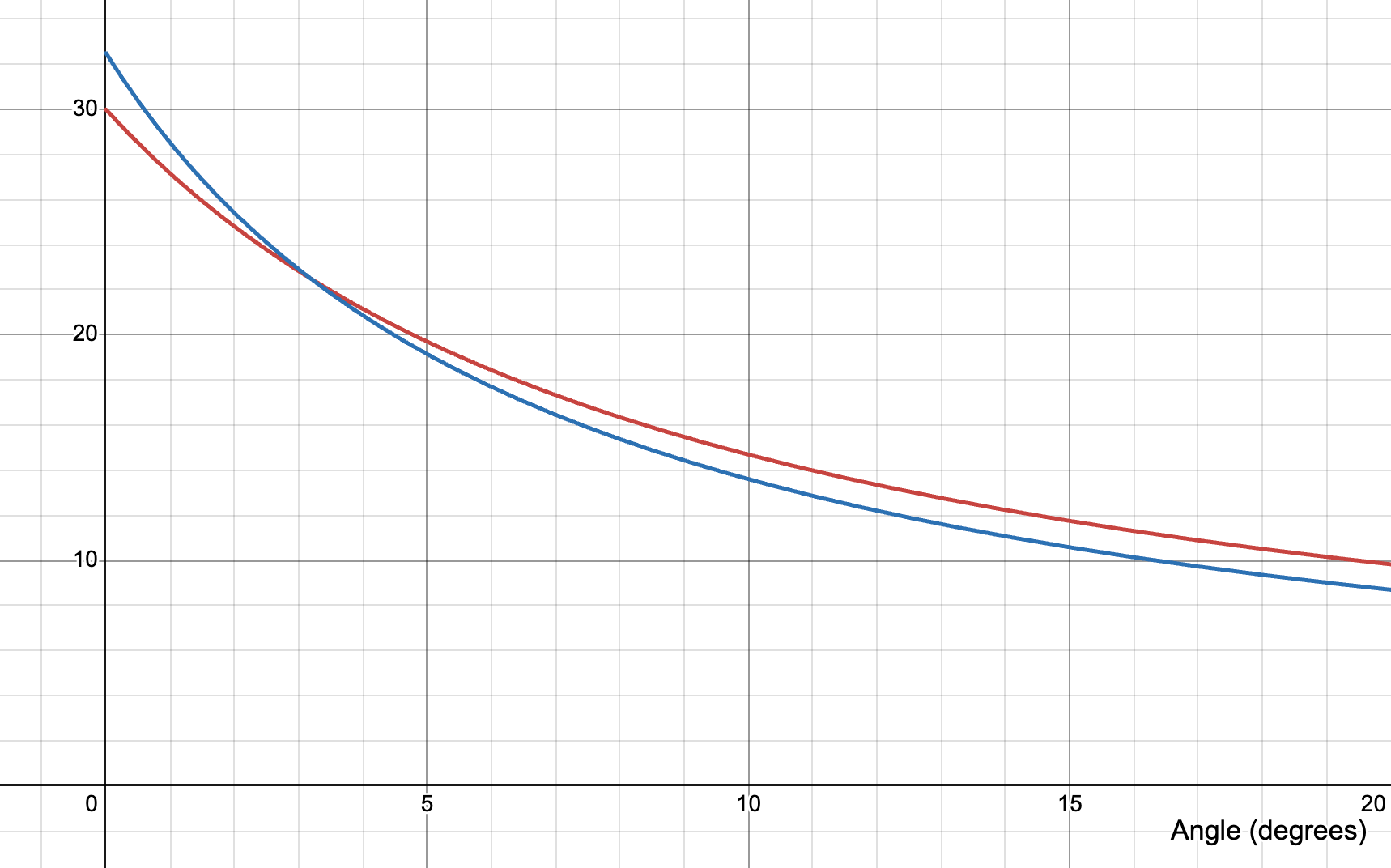
As their titles suggested, the sprinter (shown in blue) was faster on flatter terrain, while the climber (shown in red) was faster on steeper terrain. Somewhere around 3 degrees their speeds were equal.
To compute the exact speed at which this occurred, you had to set their speeds equal to each other, giving you the equation 300/(60·sin𝜃+10) = 325/(80·sin𝜃+10). Solving this gave you sin𝜽 = 1/18. Thus, 𝜃 = sin-1(1/18), or about 3.185 degrees, consistent with our estimation from the graph.
However, the puzzle asked for the gradient, or slope, of the incline. A few readers thought the slope was the ratio between an angle and 45 degrees. However, that would have meant that a 90-degree angle had a gradient of 2—in reality, the slope of a 90-degree angle is infinite.
No, the slope of a hill is instead the tangent of its angle—just as the slope is “rise over run,” an angle’s tangent is “opposite over adjacent.” Therefore, if the angle of inclination was sin-1(1/18), then the slope of the hill was tan(sin-1(1/18)). You could find an exact value for this trigonometric expression using the following (not-to-scale!) diagram:
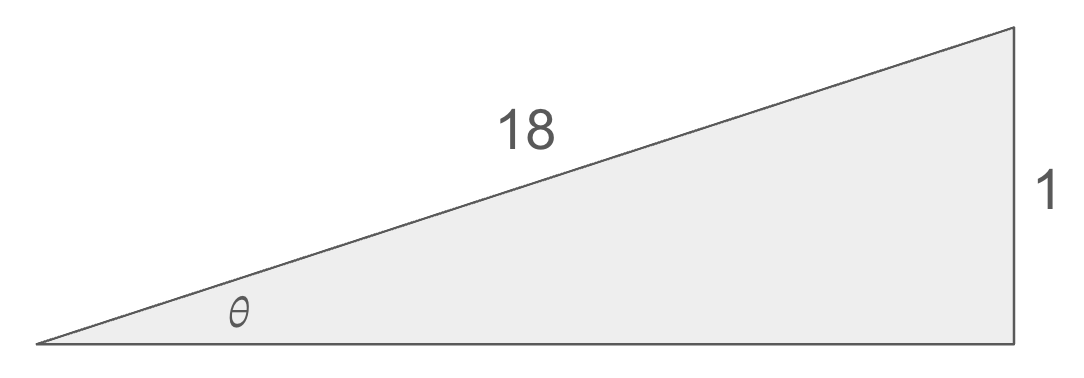
Here was an angle 𝜃 the sine of which was 1/18. By the Pythagorean theorem, the angle’s adjacent side had a length of √(182−12) = √(323). Thus, the tangent of this angle—and the slope of the hill—was 1/√(323), or approximately 0.0556, which could equivalently be written as 5.56 percent.
When 𝜃 is a small number of radians, all three of 𝜃, sin𝜃, and tan𝜃 are approximately equal. In this case, while tan𝜃 was 1/√(323) = 0.055641488…, 𝜃 was 1/18 = 0.0555555…, only about 0.1 percent smaller. Given how close these values were, I reluctantly awarded credit for answers that appeared to give either the gradient or the angle, i.e., anything between 0.055 and 0.056.
Last Week’s Extra Credit
Congratulations to the (randomly selected) winner from last week: 🎻 Ivor Traber 🎻 from Toronto, Canada. I received 31 timely submissions, of which 21 were correct—good for a 68 percent solve rate.
The climber and the sprinter were racing up a perfectly sinusoidal hill. They went from the base, where the gradient was 0 percent, to the peak, where the gradient was again 0 percent. For them to reach the top at the same time, what should the maximum gradient of the hill have been?
Importantly, the formula for v given above was for a rider’s speed along the ground. Thus, when the ground was inclined, the same speed would have covered less horizontal distance per unit time.
