
Can You Power up the Hill?
In this year’s edition of the Tour de Fiddler, your task is to find the conditions under which a climber and a sprinter will match speeds.

Welcome to Fiddler on the Proof, the spiritual successor to FiveThirtyEight’s The Riddler column.
Every Friday morning, I present mathematical puzzles intended to challenge and delight you. Most can be solved with careful thought, pencil and paper, and the aid of a calculator. The “Extra Credit” is where the analysis typically gets hairy, or where you might turn to a computer for assistance.
I’ll also give a shoutout to 🎻 one lucky winner 🎻 of the previous week’s puzzle, chosen randomly from among those who submit their solution before 11:59 p.m. the Monday after puzzles are released. I’ll do my best to read through all the submissions and give additional shoutouts to creative approaches or awesome visualizations, the latter of which could receive 🎬 Best Picture Awards 🎬.
This Week’s Fiddler
Every summer I try to run a cycling-related puzzle to coincide with the Tour de France. Previous puzzles have involved the shape of the peloton, catching the breakaway, and sprinting to the finish (not to mention three more puzzles from FiveThirtyEight). Man, I’ve been doing this for a while.
As it’s now July, the Tour de Fiddler is back!
This time, we’ll be looking at a model for a cyclist’s speed v as a function of their pedaling power P, their mass m, and the ground’s angle of inclination 𝜃:
(For the purposes of this puzzle, you needn’t worry about the units for power, mass, or speed. If you’re curious, they’re typically given in Watts, kilograms, and kilometers per hour or miles per hour, respectively.)
In cycling, roads are marked with a gradient g, which is a hill’s slope, typically expressed as a percentage. Thus, an incredibly steep 45-degree incline has a gradient of 1, or “100 percent.”
Consider the following two riders:
A “climber,” who has a power of 300 and a mass of 60
A “sprinter,” who has a power of 325 and a mass of 80
At what gradient will the climber and sprinter cycle at the same speed? (You can give your answer as a value between 0 and 1 or as a percentage.)
This Week’s Extra Credit
The climber and the sprinter are racing up a perfectly sinusoidal hill. They go from the base, where the gradient is 0 percent, to the peak, where the gradient is again 0 percent. For them to reach the top at the same time, what should the maximum gradient of the hill be? (You can give your answer as a value between 0 and 1 or as a percentage.)
Importantly, note that the formula for v given above is for a rider’s speed along the ground. Thus, when the ground is inclined, the same speed will cover less horizontal distance per unit time.
Making the ⌊Rounds⌉
There’s so much more puzzling goodness out there, I’d be remiss if I didn’t share some of it here. This week, I’m sharing a post from Fawn Nguyen, my colleague over at Amplify. Fawn is a major advocate for non-routine mathematics in schools, and this post includes a nugget from the incomparable James Tanton plus a short, inspirational video from the Global Math Project.
Want to Submit a Puzzle Idea?
Then do it! Your puzzle could be the highlight of everyone’s weekend. If you have a puzzle idea, shoot me an email. I love it when ideas also come with solutions, but that’s not a requirement.
Standings
I’m tracking submissions from paid subscribers and compiling a leaderboard, which I’ll reset every quarter. All correct solutions to Fiddlers and Extra Credits are worth 1 point each. Solutions should be sent prior to 11:59 p.m. the Monday after puzzles are released. At the end of each quarter, I’ll 👑 crown 👑 the finest of Fiddlers. If you think you see a mistake in the standings, kindly let me know.
Last Week’s Fiddler
Congratulations to the (randomly selected) winner from last week: 🎻 Aslan Buluthan Gökbulut 🎻 from Erdek, Türkiye. I received 40 timely submissions, of which 40 were correct—good for a perfect 100 percent solve rate. Great work, everyone!
When designing her new nation’s flag, Retsy Boss wanted to compactly arrange some stars. These stars were positioned along a square grid, but she only wanted to include stars whose centers were at most two units away from some point on the plane.
For example, if she had centered the circle on a star itself, then she could have placed a total of 13 stars on the flag, as shown below:
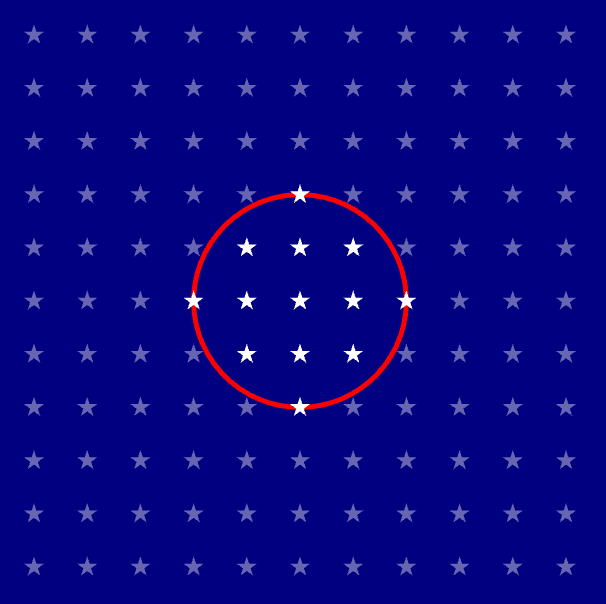
What was the greatest number of stars Retsy could have placed on the flag?
The answer was at least 13, of course, thanks to the example given above. But was it possible to do any better? Indeed it was! Consider the circle placement shown below:
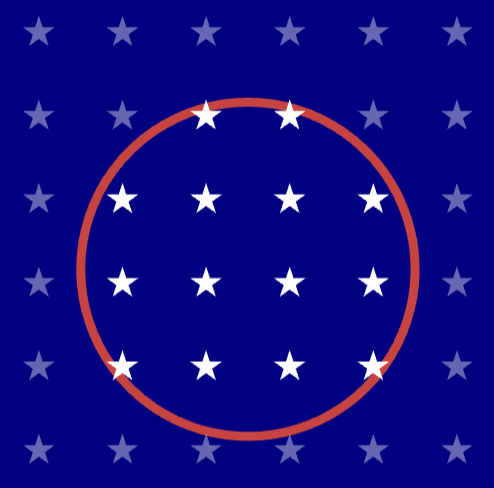
Sure enough, there were 14 stars inside this circle of radius 2. While this image was helpful, let’s prove that 14 stars fit inside the circle.
Fitting the stars was equivalent to circumscribing a circle around seven unit squares arranged as below:
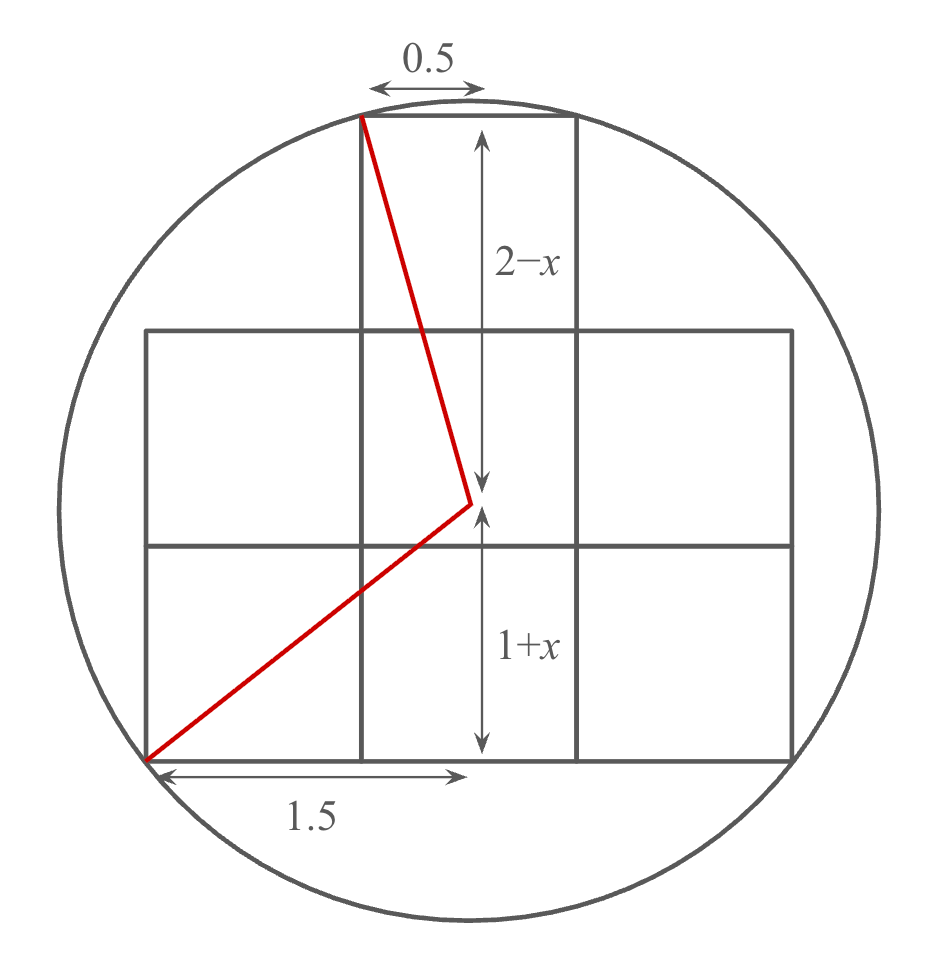
When the circle was as tight as possible around the squares, it was tangent to them at four locations, including the two shown above. The center of the circle was a distance x above the bottom row of squares such that the two red radii in the diagram had the same length.
By the Pythagorean theorem, the squares of the radii were 0.52 + (2−x)2 and 1.52 + (1+x)2. Setting these equal and solving gave you x = 1/6, which meant the radii both had a length of √(65/18), or approximately 1.9003. Since this was less than 2, that confirmed that all the squares (and thus 14 stars) fit inside a circle of radius 2.
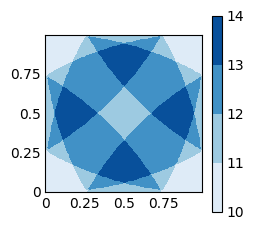
Finally, solver 🎬 Eli Wolfhagen 🎬 plotted how many stars were in the circle depending on where the circle’s center was within one of the unit squares on the grid. This value ranged from a minimum of 10 to a maximum of 14, as shown below. (Note that when the circle was centered exactly over a star, there were 13 stars in the circle, but this number dropped to 10 the moment the circle moved in any direction.)
Last Week’s Extra Credit
Congratulations to the (randomly selected) winner from last week: 🎻 Amelie Zhou 🎻 from Richmond Hill, Ontario, Canada. I received 36 timely submissions, of which 32 were correct—good for an 89 percent solve rate.
After 250 years, the nation commissioned Retsy Boss VIII to design a new flag with one star for each of the nation’s current 58 states. As an homage to the original flag design, Retsy wanted to select 58 stars from the square grid that were all at most some distance R from a point on the plane.
What was the minimum distance R that Retsy could have used?
