Can You Spot the Sheep?
Some sheep are positioned and oriented randomly in a pen. What’s the probability that each sheep can see all the other sheep?

Welcome to Fiddler on the Proof, the spiritual successor to FiveThirtyEight’s The Riddler column.
Every Friday morning, I present mathematical puzzles intended to challenge and delight you. Most can be solved with careful thought, pencil and paper, and the aid of a calculator. The “Extra Credit” is where the analysis typically gets hairy, or where you might turn to a computer for assistance.
I’ll also give a shoutout to 🎻 one lucky winner 🎻 of the previous week’s puzzle, chosen randomly from among those who submit their solution before 11:59 p.m. the Monday after puzzles are released. I’ll do my best to read through all the submissions and give additional shoutouts to creative approaches or awesome visualizations, the latter of which could receive 🎬 Best Picture Awards 🎬.
This Week’s Fiddler
Two sheep are at two random points inside a square pen. They are munching grass and staring in two random directions. Each sheep has a field of view that’s 180 degrees.
What is the probability that they both see each other?
This Week’s Extra Credit
Now, three sheep are at three random points inside a square pen. They are munching grass and staring in three random directions. As before, each sheep has a field of view that’s 180 degrees.
What is the probability that all three sheep see each other?
Making the ⌊Rounds⌉
There’s so much more puzzling goodness out there, I’d be remiss if I didn’t share some of it here. This week, I’m sharing the May puzzle from Peter Winkler and MoMath. Like last time, this one comes with an animation courtesy of Grant Sanderson.
This month’s puzzle concerns tying random ends of string together. I don’t know … something about plucking those random strings just sounds “harmonic” to me.
Want to Submit a Puzzle Idea?
Then do it! Your puzzle could be the highlight of everyone’s weekend. If you have a puzzle idea, shoot me an email. I love it when ideas also come with solutions, but that’s not a requirement.
Standings
I’m tracking submissions from paid subscribers and compiling a leaderboard, which I’ll reset every quarter. All correct solutions to Fiddlers and Extra Credits are worth 1 point each. Solutions should be sent prior to 11:59 p.m. the Monday after puzzles are released. At the end of each quarter, I’ll 👑 crown 👑 the finest of Fiddlers. If you think you see a mistake in the standings, kindly let me know.
Last Week’s Fiddler
Congratulations to the (randomly selected) winner from last week: 🎻 Rushil 🎻 from Charlotte, North Carolina. I received 57 timely submissions, of which 53 were correct—good for a 93 percent solve rate.
Last week’s puzzle was a very special collaboration between Fiddler on the Proof and Science News. Two of the four puzzles posted there served as last week’s Fiddler and Extra Credit. Now—on to those puzzles!
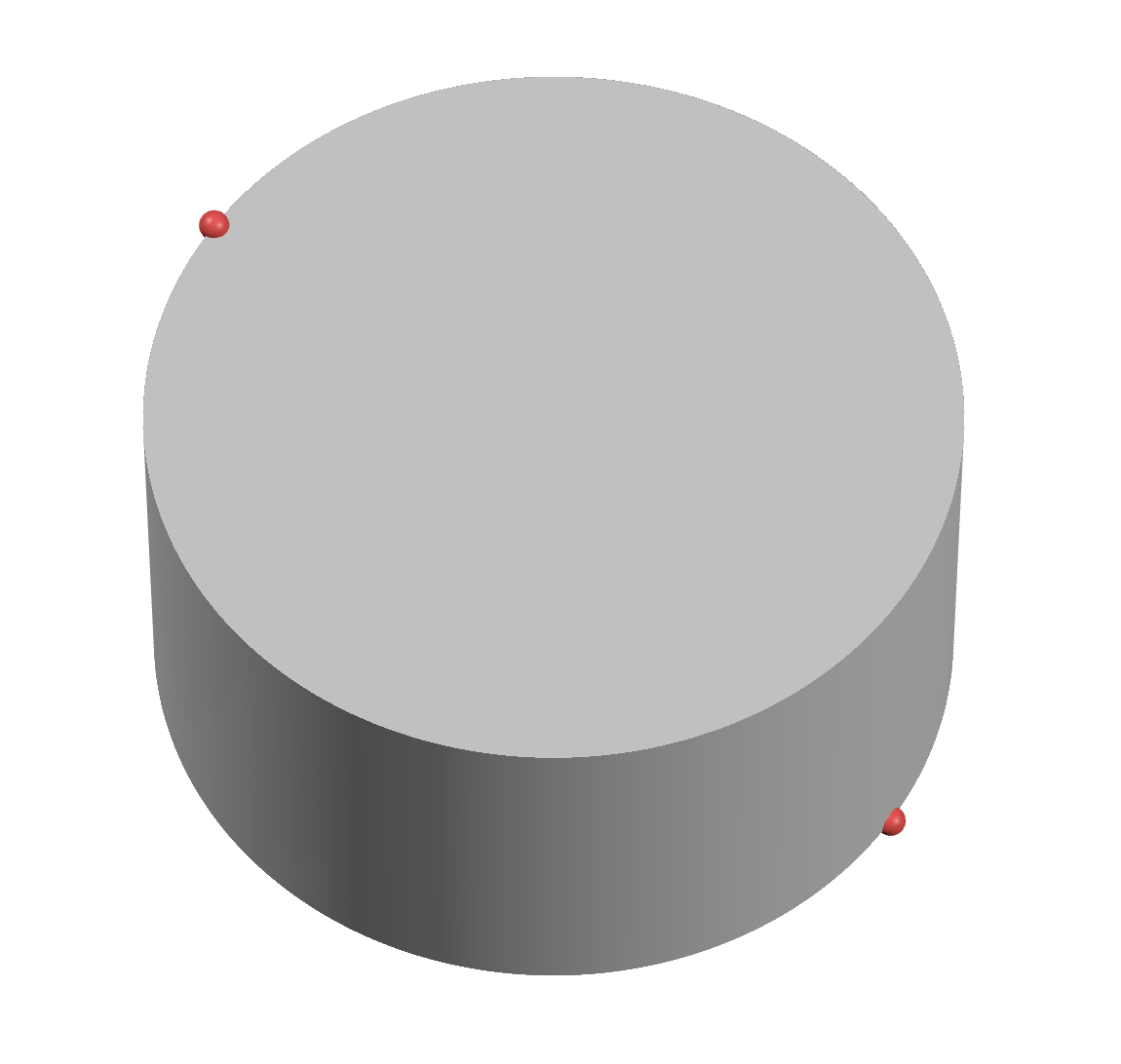
June the ant was on a cylinder. More specifically, she was on the edge of one of the cylinder’s two circular faces. Her dinner was on the edge of the opposite circular face, and all the way around on the other side of that face. The radius of the cylinder was 2 meters and its height was 2 meters.
Your job was to help June find the shortest path along the surface of the cylinder so that she could chow down as quickly as possible. What was the length of this shortest path?
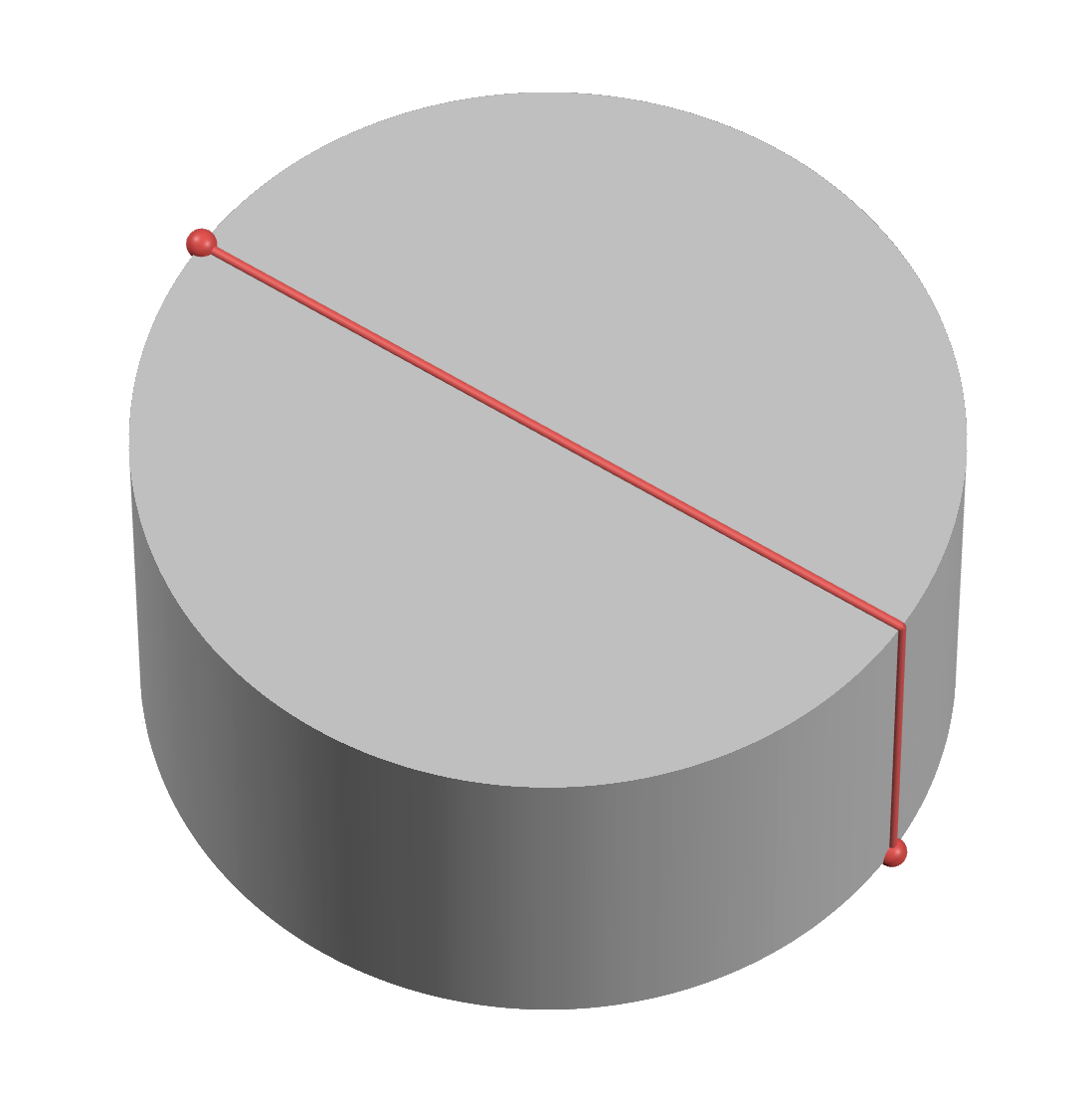
It was tempting to head straight across the circular base and then down the height, as shown below. The length of this path was the diameter, 4 meters, plus the height, 2 meters, or 6 meters in total.
An alternative path was to spiral around the curved surface of the cylinder, as shown below. If you unraveled the curved surface to form a rectangle, this path was the hypotenuse of a right triangle with a vertical leg of length 2 meters and a horizontal leg of 2𝜋 meters, which meant the total distance was √(4+4𝜋2), or about 6.59 meters.
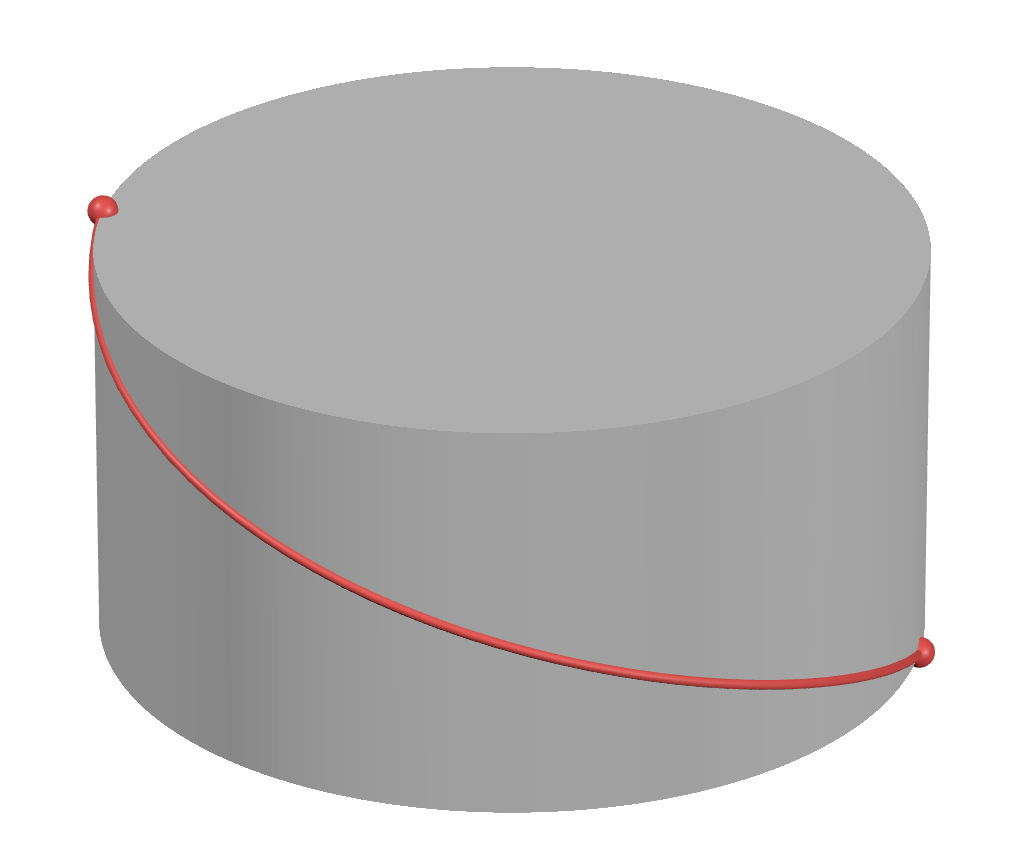
Thus, the shortest path was indeed 6 meters. If the cylinder had been taller, then eventually the curved path would have become more efficient than the straight path across the circle and down. In fact, you could calculate exactly when this transition occurred—it was when the cylinder’s height was 𝝅2/4−1, or about 1.4674, times the radius.
Last Week’s Extra Credit
Congratulations to the (randomly selected) winner from last week: 🎻 Nis Jørgensen 🎻 from Valsømagle, Denmark. I received 38 timely submissions, of which 28 were correct—good for a 74 percent solve rate.
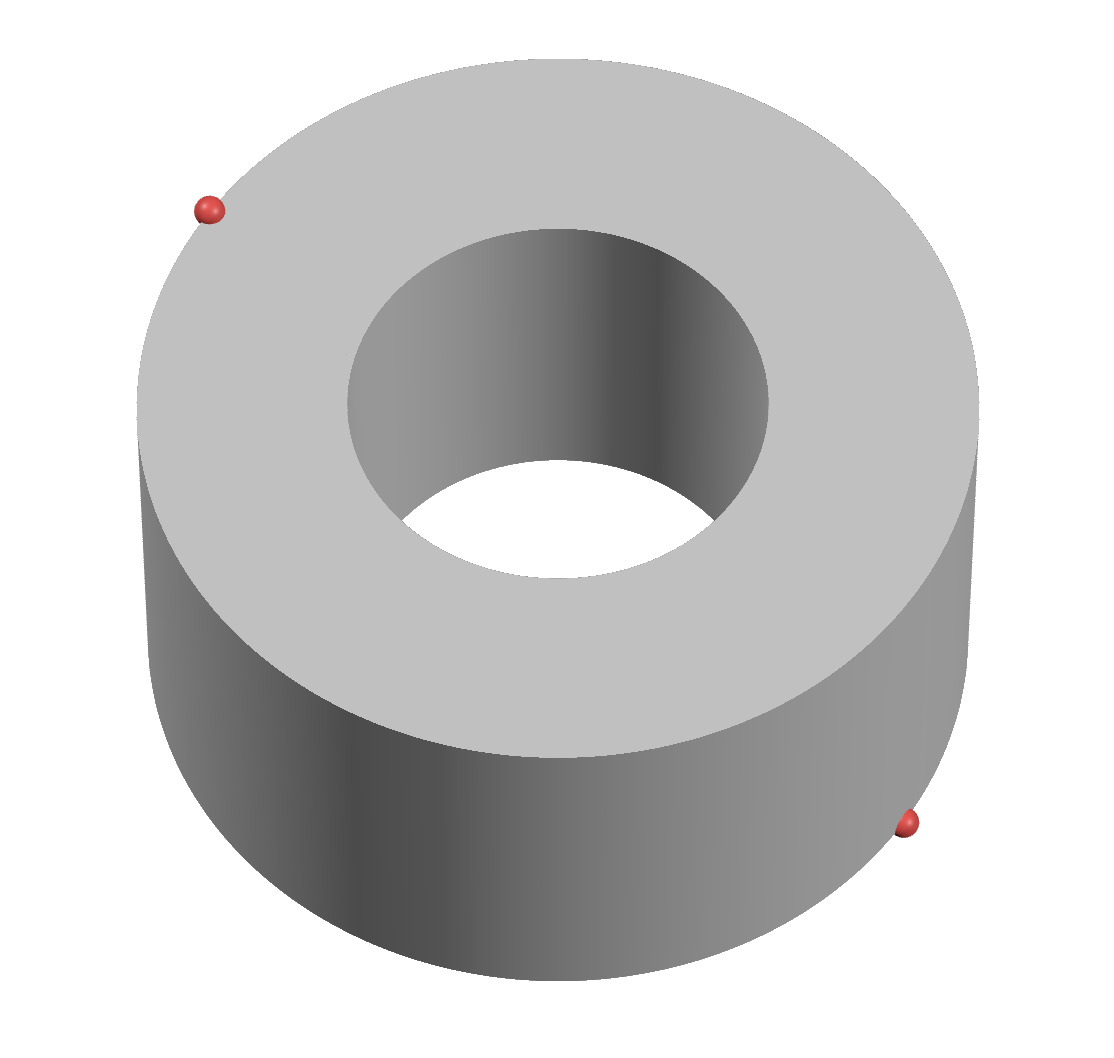
Now, June was on a hollowed-out cylinder, also known as a “cylindrical shell.” The shell’s outer radius was 2 meters and its inner radius was 1 meter. The shell was 2 meters tall. June was on the outer edge of one of the cylinder’s two flat faces. Her dinner was on the opposite face, and all the way around on the other end of that face.
Your job was to help June find the shortest path along the surface of the shell so that she could chow down as quickly as possible. What was the length of this shortest path?