
Can You Pile the Primes?
Looking at the first few primes, how many do you need so you can arrange them into three groups with equal sums? What about six groups with equal sums?

Welcome to Fiddler on the Proof, the spiritual successor to FiveThirtyEight’s The Riddler column.
Every Friday morning, I present mathematical puzzles intended to challenge and delight you. Most can be solved with careful thought, pencil and paper, and the aid of a calculator. The “Extra Credit” is where the analysis typically gets hairy, or where you might turn to a computer for assistance.
I’ll also give a shoutout to 🎻 one lucky winner 🎻 of the previous week’s puzzle, chosen randomly from among those who submit their solution before 11:59 p.m. the Monday after puzzles are released. I’ll do my best to read through all the submissions and give additional shoutouts to creative approaches or awesome visualizations, the latter of which could receive 🎬 Best Picture Awards 🎬.
This Week’s Fiddler
From Dean Ballard comes a premier puzzle of primes:
Suppose you want to make two groups with equal sums using the first N2 prime numbers. What is the smallest value of N2 for which you can do this?
The answer is three! (Clearly, that wasn’t actually the puzzle.)
The first three primes are 2, 3, and 5, and you can split them up into two sets: {2, 3} and {5}. Sure enough, 2 + 3 = 5.
Your puzzle involves making three groups with equal sums using the first N3 prime numbers. What is the smallest value of N3 for which you can do this?
This Week’s Extra Credit
Now you want to make six groups with equal sums using the first N6 prime numbers. What is the smallest value of N6 for which you can do this?
Making the ⌊Rounds⌉
There’s so much more puzzling goodness out there, I’d be remiss if I didn’t share some of it here. This week, I’m sharing a March Madness-themed puzzle from Emma R. Hasson over at Scientific American. It’s one of those “there’s not enough information until folks say there’s not enough information” logic puzzles that are a lot of fun. Enjoy!
Want to Submit a Puzzle Idea?
Then do it! Your puzzle could be the highlight of everyone’s weekend. If you have a puzzle idea, shoot me an email. I love it when ideas also come with solutions, but that’s not a requirement.
Standings
I’m tracking submissions from paid subscribers and compiling a leaderboard, which I’ll reset every quarter. All correct solutions to Fiddlers and Extra Credits are worth 1 point each. Solutions should be sent prior to 11:59 p.m. the Monday after puzzles are released. At the end of each quarter, I’ll 👑 crown 👑 the finest of Fiddlers. If you think you see a mistake in the standings, kindly let me know.
Last Week’s Fiddler
Congratulations to the (randomly selected) winner from last week: 🎻 Randy Hickman 🎻 from Houston, Texas. I received 55 timely submissions, of which 41 were correct—good for a 75 percent solve rate.
Last week, I had a loop of string whose total length was 10. I placed it around a unit disk (i.e., with radius 1) and pulled a point on the string away from the disk until the string was taut, as shown below.
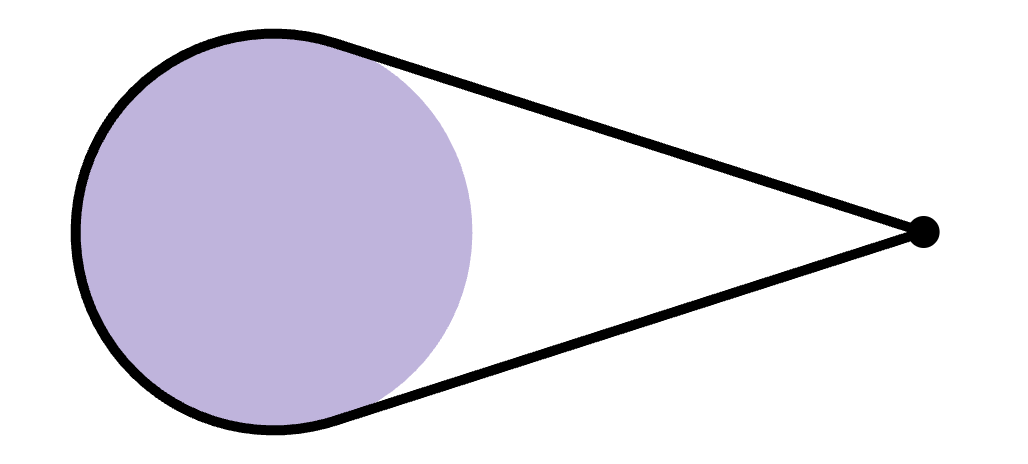
I dragged this point around the disk in all directions, always keeping the string taut, tracing out a loop. What was the area inside this resulting loop?
Before we get to any area calculations, what was the shape of the resulting loop? Thanks to the symmetry in the problem, the string itself always maintained the same overall shape, no matter which direction you were pulling the point. That meant the point was always the same distance from the center of the disk, and the loop was therefore a circle. The radius of that circle was indeed the distance between the point and the disk’s center.
So to find the area, we needed to find that radius. And to do that, it was helpful to split the string up into two regions, as shown below: the straight regions (in red) and the circular region (in blue), which met at points of tangency.
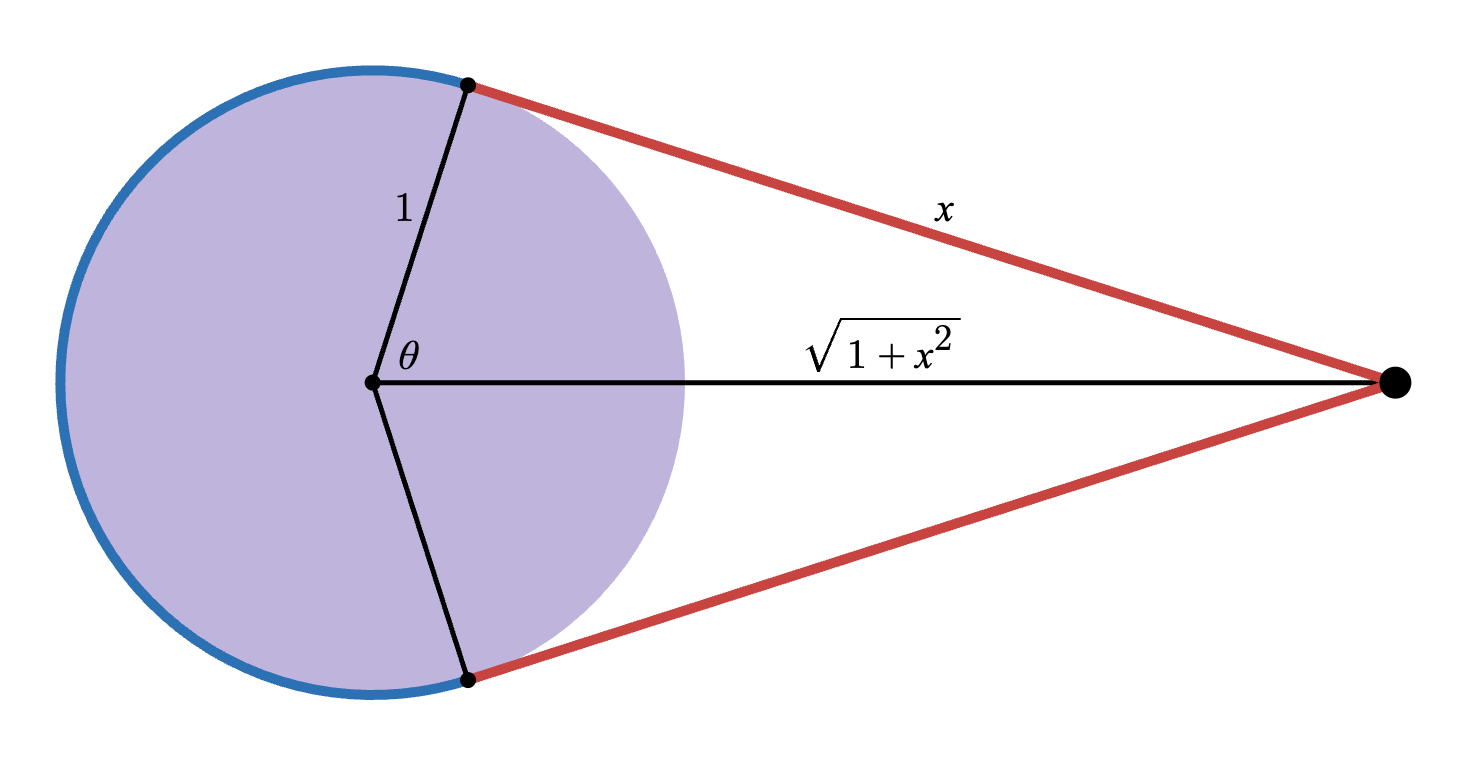
Suppose the length of each straight red segment was x, and the angle between the point, the center of the disk, and a point of tangency was 𝜽. Then x = tan(𝜽), while the radius of the circular region of interest was √(1 + x2). The latter meant the area of the circular region was 𝝅·(1 + x2), so all we had to do was determine the value of x.
The combined length of the straight red segments was 2x. Meanwhile, the blue arc had a central angle of 2𝝅 − 2𝜽 radians. Because it was a unit circle, the arc’s length was then 2𝝅 − 2𝜽 as well. Adding the straight and curved lengths together gave you the an expression for the total length of the string, 2𝝅 − 2𝜽 + 2x, which the puzzle stated had to equal 10.
Setting these equal gave you the equation 2𝝅 − 2𝜽 + 2x = 10, or 𝝅 − 𝜽 + x = 5. Recalling that x = tan(𝜽), or, equivalently, that 𝜽 = tan-1(x), the equation became 𝝅 − tan-1(x) + x = 5. Alas, this was a transcendental equation that had to be solved numerically. It turned out that x was approximately 3.119. (This value was somewhat close to 𝝅, which was just a coincidence.)
We said the area of the circular region was 𝝅·(1 + x2). Plugging in 3.119 for x gave an area of approximately 33.7 square units. (I gave credit to any answer that rounded to 33.7.)
Last Week’s Extra Credit
Congratulations to the (randomly selected) winner from last week: 🎻 Izumihara Ryoma 🎻 from Toyooka, Japan. I received 33 timely submissions, of which 23 were correct—good for a 70 percent solve rate. (As is often the case around here, simply attempting this puzzle required significant gumption and skill, hence the rather high solve rate.)
Now I had a loop of string whose total length was 14, and I placed it around two adjacent unit disks. As before, I pulled a point on the string away from the disks until the string was taut, as shown below.
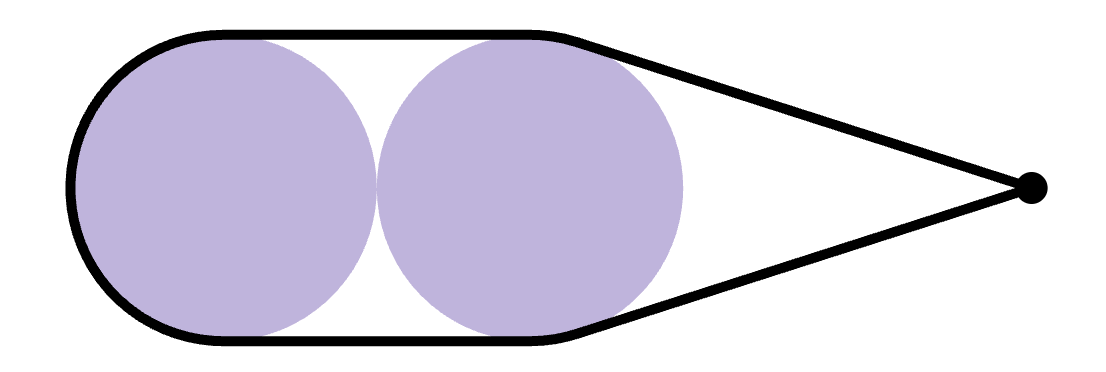
I dragged this point around the disks in all directions, always keeping the string taut, tracing out a loop. What was the area inside this resulting loop?
