
Can You Trace the Locus?
You wrap a string around a circle (or two) and pull the string taut. What is the area of the resulting region you can trace out?

Welcome to Fiddler on the Proof, the spiritual successor to FiveThirtyEight’s The Riddler column.
Every Friday morning, I present mathematical puzzles intended to challenge and delight you. Most can be solved with careful thought, pencil and paper, and the aid of a calculator. The “Extra Credit” is where the analysis typically gets hairy, or where you might turn to a computer for assistance.
I’ll also give a shoutout to 🎻 one lucky winner 🎻 of the previous week’s puzzle, chosen randomly from among those who submit their solution before 11:59 p.m. the Monday after puzzles are released. I’ll do my best to read through all the submissions and give additional shoutouts to creative approaches or awesome visualizations, the latter of which could receive 🎬 Best Picture Awards 🎬.
This Week’s Fiddler
I have a loop of string whose total length is 10. I place it around a unit disk (i.e., with radius 1) and pull a point on the string away from the disk until the string is taut, as shown below.
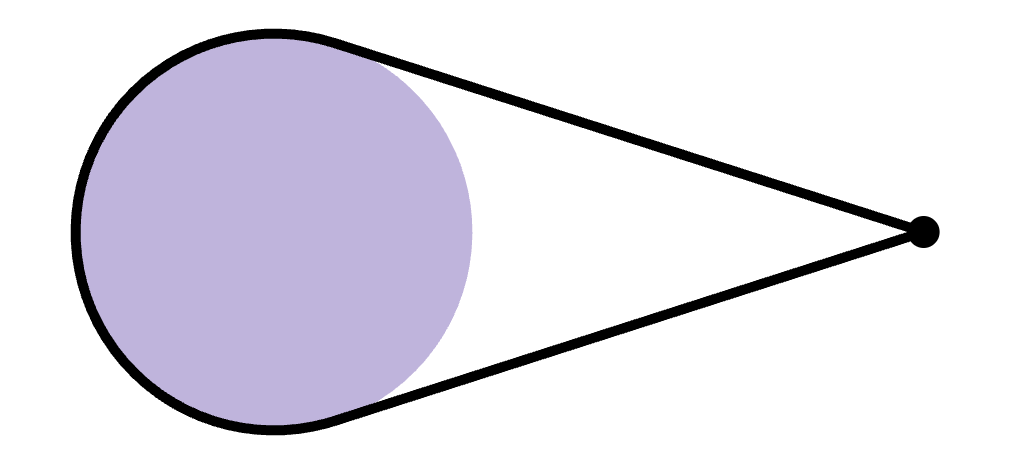
I drag this point around the disk in all directions, always keeping the string taut, tracing out a loop. What is the area inside this resulting loop?
This Week’s Extra Credit
Now I have a loop of string whose total length is 14, and I place it around two adjacent unit disks. As before, I pull a point on the string away from the disks until the string is taut, as shown below.
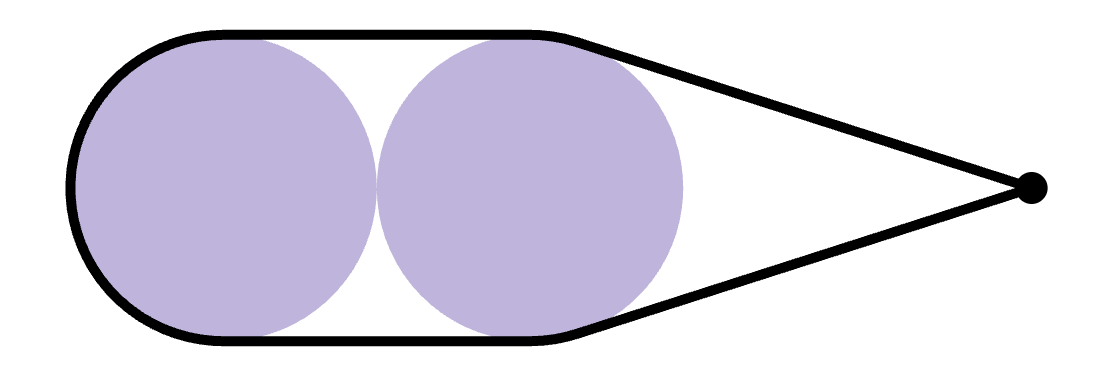
I drag this point around the disks in all directions, always keeping the string taut, tracing out a loop. What is the area inside this resulting loop?
Making the ⌊Rounds⌉
There’s so much more puzzling goodness out there, I’d be remiss if I didn’t share some of it here. This week, I’m sharing my regression analysis for the men’s and women’s college basketball tournaments (also known as “March Madness.”)
At the time of this writing, my men’s bracket is doing so-so. But over on the women’s side, 11-seeded Nebraska looked pretty good in the second half of their play-in game against Richmond. My math said Nebraska should have been a 6- or a 7-seed, so there you go.
Want to Submit a Puzzle Idea?
Then do it! Your puzzle could be the highlight of everyone’s weekend. If you have a puzzle idea, shoot me an email. I love it when ideas also come with solutions, but that’s not a requirement.
Standings
I’m tracking submissions from paid subscribers and compiling a leaderboard, which I’ll reset every quarter. All correct solutions to Fiddlers and Extra Credits are worth 1 point each. Solutions should be sent prior to 11:59 p.m. the Monday after puzzles are released. At the end of each quarter, I’ll 👑 crown 👑 the finest of Fiddlers. If you think you see a mistake in the standings, kindly let me know.
Last Week’s Fiddler
Congratulations to the (randomly selected) winner from last week: 🎻 Jason Winerip 🎻 from Phoenix, Arizona. I received 53 timely submissions, of which 47 were correct—good for an 89 percent solve rate.
Last week, I started with a number line from 0 to 1 and removed the middle third. Then I took each of the remaining pieces (the segment from 0 to 1/3 and the segment from 2/3 to 1) and removed their middle thirds. Now I had four segments (from 0 to 1/9, 2/9 to 1/3, 2/3 to 7/9, and 8/9 to 1) and I removed their middle thirds. I did this over and over again, infinitely many times.
The points I was left with are collectively known as the Cantor set. The Cantor set is not empty; in fact, it contains infinitely many points on the number line, such as 0, 1, 1/3, and even 1/4.
It’s possible to pick a random point in the Cantor set in the following way: Start with the entire number line from 0 to 1. Then, every time you remove a middle third, you give yourself a 50 percent chance of being on the left remaining third and a 50 percent chance of being on the right remaining third. Then, when you remove the middle third of that segment, you again give yourself a 50 percent chance of being on the left vs. the right, and so on.
If I independently picked two random points in the Cantor set, then how far apart should I have expected them to be, on average?
The Cantor set is a famous fractal, meaning as you zoom in or out it exhibits the same repeating structure. When looking at the number line from 0 to 1, the Cantor set is missing the middle third, and there are other gaps throughout. If you zoom in to the segment from 0 to 1/3, it looks very much the same—it’s missing the middle third, and there are other gaps throughout. It seemed only fair to take advantage of this fractal nature when solving the puzzle.
Suppose the answer to the puzzle was some number L. That is, L was the average distance between two points from across the Cantor set, from 0 to 1. Each point, independently of the other, had a 50 percent chance of being between 0 and 1/3 and a 50 percent chance of being between 2/3 and 1. Therefore, in picking two points, there were four equally likely cases:
Both numbers were between 0 and 1/3.
Both numbers were between 2/3 and 1.
The first number I picked was between 0 and 1/3, while the second number I picked was between 2/3 and 1.
The first number I picked was between 2/3 and 1, while the second number I picked was between 0 and 1/3.
If I happened to be within the first case, where both numbers were between 0 and 1/3, the whole Cantor set had effectively been shrunk down by a factor of three, so the average distance between the points was L/3. The same was true in the second case, when both numbers happened to be between 2/3 and 1.
If I happened to be within the third case or fourth cases, then things got a little more interesting. Suppose the number between 2/3 and 1 was equal to 2/3 + x, so that 0 ≤ x ≤ 1/3, while the number between 0 and 1/3 was y. Note that x and y had precisely the same probability distributions, since the two segments of the Cantor set were indistinguishable from each other (other than a shift up or down by 2/3).
The distance between the two numbers, 2/3 + x and y, was the absolute value of their difference: |(2/3 + x) − y|, or |2/3 + x − y|. Now, because x and y were both between 0 and 1/3, there was no way that x − y could have been greater than 2/3, which meant the expression inside the absolute value function was never negative. Dropping the unnecessary absolute value meant the distance was simply 2/3 + x − y. The expected value of this expression was 2/3 plus the expected value of x − y. Finally, since x and y were both picked from the same distribution, the average distance between them was zero.
The end result of this analysis was that, in the last two cases, when the two points came from two different sub-segments, the average distance between them was precisely 2/3. (Note the lack of any dependence on L here.)
Putting this all together, we could write a single equation for L that broke it down into each of the four cases: L = (1/4)·(L/3) + (1/4)·(L/3) + (1/4)·(2/3) + (1/4)·(2/3). Again, the left side of this equation was just L, while the right side leveraged the fractal nature of the Cantor set—in particular, that the average distance scaled down by a factor of three any time you zoomed in.
The equation could be simplified to L = L/6 + 1/3, or (5/6)·L = 1/3. Solving for L gave you 2/5, or 0.4. Wait a minute, the Cantor set was all about thirds, thirds, thirds—how did fifths get into the picture? (Neat, right?)
Last Week’s Extra Credit
Congratulations to the (randomly selected) winner from last week: 🎻 Joel Lewis 🎻 from Rockville, Maryland. I received 40 timely submissions, of which 33 were correct—good for an 82.5 percent solve rate.
Suppose I independently picked three random points in the Cantor set. Each point had some value between 0 and 1.
What was the probability that these three values could have been the side lengths of a triangle?
