
Can Every Day Be First?
In 2026, every day of the week is the first day of at least one month. Does this happen every year?

Welcome to Fiddler on the Proof, the spiritual successor to FiveThirtyEight’s The Riddler column.
Every Friday morning, I present mathematical puzzles intended to challenge and delight you. Most can be solved with careful thought, pencil and paper, and the aid of a calculator. The “Extra Credit” is where the analysis typically gets hairy, or where you might turn to a computer for assistance.
I’ll also give a shoutout to 🎻 one lucky winner 🎻 of the previous week’s puzzle, chosen randomly from among those who submit their solution before 11:59 p.m. the Monday after puzzles are released. I’ll do my best to read through all the submissions and give additional shoutouts to creative approaches or awesome visualizations, the latter of which could receive 🎬 Best Picture Awards 🎬.
This Week’s Fiddler
In 2026, every day of the week is the first day of the month at least once:
Monday is June 1.
Tuesday is September 1 and December 1.
Wednesday is April 1 and July 1.
Thursday is January 1 and October 1.
Friday is May 1.
Saturday is August 1.
Sunday is February 1, March 1, and November 1.
Is 2026 special in this regard? If so, when is the next year when one of the days of the week is not represented among the firsts of the month? Otherwise, if 2026 is not special in this regard, then why not?
This Week’s Extra Credit
As we just noted, in 2026, all seven days of the week appear as the first of the month at least once. But you know, I decided that I don’t like that at all. Instead, I want as few days of the week as possible to appear as the first of the month in a given year.
To accomplish this, I have been granted the authority to change the number of days in each of that year’s 12 months, provided that there are still 365 or 366 days in the year and each month has at least 28 days and at most 31 days.
What are the fewest days of the week that can appear as the first of the month in such a calendar year? (And for fun, rather than for credit: How many such calendars can you design with this property?)
Making the ⌊Rounds⌉
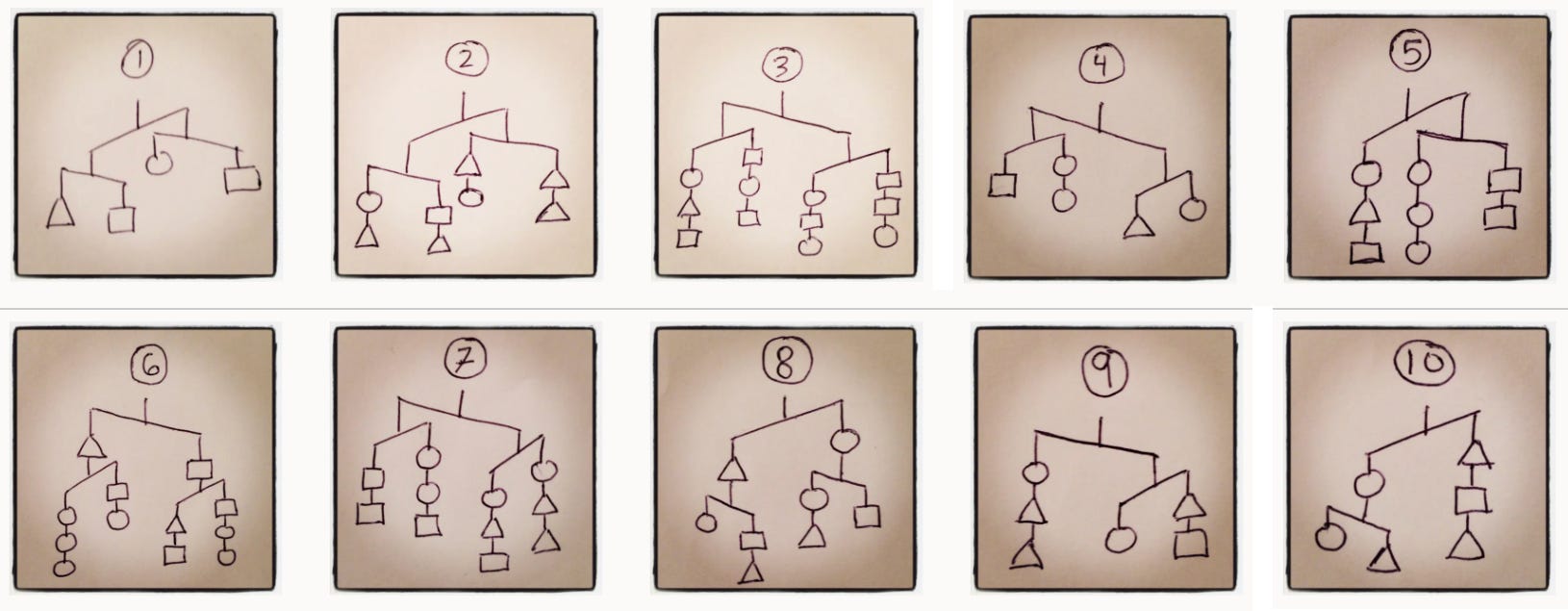
There’s so much more puzzling goodness out there, I’d be remiss if I didn’t share some of it here. This week, I’m sharing 15 visual problems from Paul Salomon, which made their way to the Substack of my Amplify colleague, Dan Meyer, by way of Michael Pershan. (That’s quite a game of telephone!)
For each puzzle, order the shapes (triangle, square, circle) by weight:
Want to Submit a Puzzle Idea?
Then do it! Your puzzle could be the highlight of everyone’s weekend. If you have a puzzle idea, shoot me an email. I love it when ideas also come with solutions, but that’s not a requirement.
Standings
I’m tracking submissions from paid subscribers and compiling a leaderboard, which I’ll reset every quarter. All correct solutions to Fiddlers and Extra Credits are worth 1 point each. Solutions should be sent prior to 11:59 p.m. the Monday after puzzles are released. At the end of each quarter, I’ll 👑 crown 👑 the finest of Fiddlers. If you think you see a mistake in the standings, kindly let me know.
Last Week’s Fiddler
Congratulations to the (randomly selected) winner from last week: 🎻 Ryan Goldenberg 🎻 from Nutley, New Jersey. I received 79 timely submissions, of which 73 were correct—good for a 92 percent solve rate.
Two logicians were trying to earn a fabulous prize as a team. There were three targets and, to win the prize, each logician had to fire a single arrow and hit the same target as the other. Two of the targets were closer but were otherwise indistinguishable; the logicians knew they each had a 98 percent chance of hitting either of these targets. The third target was farther away; the logicians knew they each had a 70 percent chance of hitting that target.
The logicians couldn’t cooperate or consult in advance, and they had no prior knowledge of which target their counterpart was aiming for or whether they were successful.
What was the probability they would win the prize?
Let’s pretend we’re one of the two logicians. If we had decided to aim for one of the first two targets, then our fellow logician would surely have done the same. However, since the two targets were indistinguishable, we couldn’t guarantee that the two of us were aiming for the same target. Whichever target you were aiming for, there was a 98 percent chance you hit it, a 50 percent chance your partner aimed for that same target, and then a 98 percent chance they too hit the target. Multiplying the probabilities of these independent events together, the chances of winning with this strategy were 0.98 × 0.5 × 0.98 = 0.4802, or 48.02 percent.
If, on the other hand, we had decided to aim for the third target, then once again our fellow logician would surely have done the same. Since this target was distinct, our chances of winning were now 0.7 × 0.7 = 0.49, or 49 percent.
Because 49 percent was greater than 48.02 percent, the logicians must have (logically) aimed for the third target and therefore had a 49 percent chance of winning the prize.
By the way, a “mixed” strategy, in which each logician randomly chose a target in some way, wouldn’t have fared any better. To prove this, suppose they aimed for the third target with probability p and the indistinguishable targets with probability 1−p. Their chances of winning were then 0.49·p + 0.4802·(1−p), an expression that was maximized when p = 1.
Finally, it’s worth noting that if the probability of hitting the third target was at least 1/√2, or about 70.71 percent, then aiming for the third target remained the best strategy even if hitting one of the other two targets was a sure thing.
Last Week’s Extra Credit
Congratulations to the (randomly selected) winner from last week: 🎻 Dan Katz 🎻 from North Attleboro, Massachusetts. I received 57 timely submissions, of which 52 were correct—good for a 91 percent solve rate.
As before, there were still three targets, but their respective probabilities of being struck had changed. That said, two of the targets remained indistinguishable from each other and had the same probability of being struck. Moreover, all three probabilities were rational.
After doing some mental arithmetic, the logicians realized that it didn’t matter which target they aimed for—their probability of winning the prize was the same no matter what.
What was their probability of winning the prize?
