
Can the Archers Coordinate?
Two archers must choose from among three targets. If they hit the same target, they win a prize. The catch? They can’t tell each other which target they’re aiming for.

Welcome to Fiddler on the Proof, the spiritual successor to FiveThirtyEight’s The Riddler column.
Every Friday morning, I present mathematical puzzles intended to challenge and delight you. Most can be solved with careful thought, pencil and paper, and the aid of a calculator. The “Extra Credit” is where the analysis typically gets hairy, or where you might turn to a computer for assistance.
I’ll also give a shoutout to 🎻 one lucky winner 🎻 of the previous week’s puzzle, chosen randomly from among those who submit their solution before 11:59 p.m. the Monday after puzzles are released. I’ll do my best to read through all the submissions and give additional shoutouts to creative approaches or awesome visualizations, the latter of which could receive 🎬 Best Picture Awards 🎬.
This Week’s Fiddler
From Bart Wright comes a tale of two archers:
Two logicians are trying to earn a fabulous prize as a team. There are three targets, and, to win the prize, each logician must fire a single arrow and hit the same target as the other. Two of the targets are closer but are otherwise indistinguishable; the logicians know they each have a 98 percent chance of hitting either of these targets. The third target is farther away; the logicians know they each have a 70 percent chance of hitting that target.
The logicians can’t cooperate or consult in advance, and they have no knowledge of which target their counterpart is aiming for or whether they are successful.
What is the probability they will win the prize?
This Week’s Extra Credit
As before, there are still three targets, but their respective probabilities of being struck have changed. That said, two of the targets remain indistinguishable from each other and have the same probability of being struck. Moreover, all three probabilities are rational.
After doing some mental arithmetic, the logicians realize that it doesn’t matter which target they aim for—their probability of winning the prize is the same no matter what.
What is their probability of winning the prize?
Making the ⌊Rounds⌉
There’s so much more puzzling goodness out there, I’d be remiss if I didn’t share some of it here. This week, I’m sharing a “Monthly Mindbender” from Peter Winkler. Here’s the puzzle for February:
A bacterium begins at the origin on the plane grid. At time 1, it divides into two bacteria that will sit just north and east of the parent, that is, at points (0, 1) and (1, 0). In general, at any time, any bacterium that has room to divide may do so; that is, if a bacterium sits at the point (x, y), it may be replaced by a bacterium at (x, y+1) and another at (x+1, y) if those points were unoccupied.
Roughly, how many divisions must take place before the closed box with corners at (0,0), (0,3), (3,3), and (3,0) is clear of bacteria?
The MoMath site where the puzzle is posted says it’s a “[v]ariation of a puzzle posed by Fields Medal winner Maxim Kontsevich,” which I believe you can find here.
I haven’t spent too long with this puzzle just yet, but I’ll provide a few clarifications. First, the bacteria can’t divide simultaneously. So when there are bacteria at (0, 1) and (1, 0), you can choose which of them divides first. If you choose the bacterium at (1, 0), then there will be new bacteria at (2, 0) and (1, 1), the latter of which prevents the bacterium at (0, 1) from dividing next.
Also, to firm this problem up, I’d ask for the minimum number of divisions needed to clear out the box, rather than for the “rough” number of divisions … provided that clearing out the box is even possible!
Ah, it appears that Grant Sanderson, who is collaborating with MoMath on these puzzles, issued the same clarifications in a recent Substack note.
Want to Submit a Puzzle Idea?
Then do it! Your puzzle could be the highlight of everyone’s weekend. If you have a puzzle idea, shoot me an email. I love it when ideas also come with solutions, but that’s not a requirement.
Standings
I’m tracking submissions from paid subscribers and compiling a leaderboard, which I’ll reset every quarter. All correct solutions to Fiddlers and Extra Credits are worth 1 point each. Solutions should be sent prior to 11:59 p.m. the Monday after puzzles are released. At the end of each quarter, I’ll 👑 crown 👑 the finest of Fiddlers. If you think you see a mistake in the standings, kindly let me know.
Last Week’s Fiddler
Congratulations to the (randomly selected) winner from last week: 🎻 Jason Weisman 🎻 from Wilton, Connecticut. I received 43 timely submissions, of which 36 were correct—good for an 84 percent solve rate.
Last week, a rover was dropped down on a spherical planet with a radius of 1000 miles. The rover had been programmed with a very specific set of motions:
First, it moved straight forward a fixed distance s, and stopped.
Without moving forward, it turned left 60 degrees. (Importantly, the rover turned 60 degrees, not 120 degrees.)
Next, the rover moved straight forward in this new direction another distance s, and stopped.
Without moving forward, it again turned left 60 degrees.
Finally, the rover moved straight forward in this new direction another distance s, and stopped.
To be picked up, the rover had to complete its journey in the same place it was dropped down. What was the minimum value of s, with s > 0, for which this worked?
To help you out, the puzzle’s author, Pierre Bierre, sketched what such a path looked like:
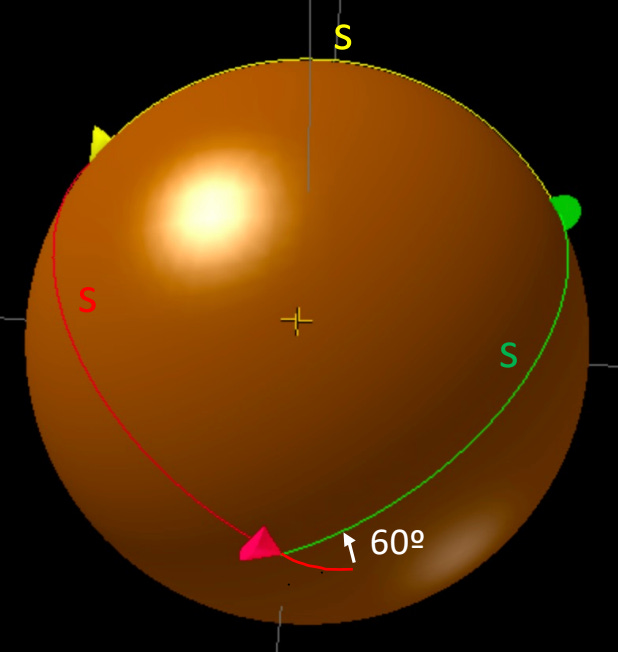
The rover blazed a triangular path with three equal legs and three equal angles. That meant the pat was an equilateral triangle. But unlike equilateral triangles on flat surfaces, where all three internal angles measure 60 degrees, the angles in equilateral triangles on curved surfaces can have other measures. On spherical surfaces, the angles are all greater than 60 degrees; for this particular path, the angles inside the triangle each happened to be 120 degrees.
Several readers applied the spherical law of cosines, which states that, for a triangle on a unit sphere with side lengths a, b, c and opposite angles A, B, and C: cos(c) = cos(a)·cos(b) + sin(a)·sin(b)·cos(C). Here, we had an equilateral triangle with a = b = c and A = B = C = 2𝛑/3 radians. Plugging these values into the formula gave you cos(a) = cos2(a) + sin2(a)·cos(2𝛑/3).
Since cos(2𝛑/3) = -1/2, some rearrangement gave you the equation 3·cos2(a) − 2·cos(a) − 1 = 0, which was quadratic in terms of cos(a). Factoring gave you (cos(a) − 1)(3·cos(a) + 1) = 0. The first factor resulted in the trivial solution a = 0, while the second gave you a = cos-1(-1/3), or about 1.911 radians. (Note the minus sign inside the parentheses! If you missed that, then you got an incorrect value of 𝛑 − 1.911, or about 1.231 radians.)
What exactly was a? It was the triangle’s side length if the planet had been a unit sphere, i.e., with radius 1. Scaling this up to a planet with a radius of 1000 miles meant that s was 1000 times greater, or approximately 1911 miles. I accepted various equivalent answers, including 1000·cos-1(-1/3), 2000·tan-1(√2), etc.
Last Week’s Extra Credit
Congratulations to the (randomly selected) winner from last week: 🎻 Kiera Jones 🎻 from Cincinnati, Ohio. I received 38 timely submissions, of which 26 were correct—good for a 68 percent solve rate.
There were other values of s for which the rover would end its journey where it was dropped down. How many such positive values of s (including the answer you just found in the Fiddler) were less than 100,000 miles?
