
Can You Reach the Edge of the Square?
Starting from the center of a square, pick a random direction. On average, how far must you travel in that direction to reach the edge of the square?

Welcome to Fiddler on the Proof, the spiritual successor to FiveThirtyEight’s The Riddler column.
Every Friday morning, I present mathematical puzzles intended to challenge and delight you. Most can be solved with careful thought, pencil and paper, and the aid of a calculator. The “Extra Credit” is where the analysis typically gets hairy, or where you might turn to a computer for assistance.
I’ll also give a shoutout to 🎻 one lucky winner 🎻 of the previous week’s puzzle, chosen randomly from among those who submit their solution before 11:59 p.m. the Monday after puzzles are released. I’ll do my best to read through all the submissions and give additional shoutouts to creative approaches or awesome visualizations, the latter of which could receive 🎬 Best Picture Awards 🎬.
This Week’s Fiddler
You start at the center of the unit square and then pick a random direction to move in, with all directions being equally likely. You move along this chosen direction until you reach a point on the perimeter of the unit square.
On average, how far can you expect to have traveled?
This Week’s Extra Credit
Let’s raise the stakes by a dimension. Now, you start at the center of a unit cube. Again, you pick a random direction to move in, with all directions being equally likely. You move along this direction until you reach a point on the surface of the unit cube.
On average, how far can you expect to have traveled?
Making the ⌊Rounds⌉
There’s so much more puzzling goodness out there, I’d be remiss if I didn’t share some of it here. This week, I’m sharing a puzzle from Adam Landsberg that originally appeared as a Letter to the Editors in The Mathematical Intelligencer, when Adam submitted it back in 2009. More than a decade later, it’s still a fantastic puzzle. It’s titled, “The Return of Monty Hall.” From Adam:
In a new (“Let’s-Make-A-Deal”-type) game show for couples, there are three curtains behind which are (hidden) a car, a car key, and a goat. One member of the couple is designated “the car-master,” whose goal is to find the car. The other member is designated “the key-master,” whose goal is to find the key.
If both partners succeed in their respective tasks, the couple drives away in their new car. If either one fails, the couple receives the booby prize, the goat.
The game begins with the car-master. (At this point, the key-master is led out of the room and cannot observe the proceedings.) The car-master has two tries to find the car (i.e., open any curtain; if the car isn’t there, then open another curtain). If the car-master succeeds in finding the car, all open curtains (including the one with the car) are reclosed, and the key-master is brought back into the room. No communication whatsoever is permitted between the car-master and key-master at this point. The key-master now has two tries to find the key (i.e., open any curtain; if the key isn’t there, open another curtain).
Assuming the couple plays optimally, what are their chances of winning the car?
Want to Submit a Puzzle Idea?
Then do it! Your puzzle could be the highlight of everyone’s weekend. If you have a puzzle idea, shoot me an email. I love it when ideas also come with solutions, but that’s not a requirement.
Standings
I’m tracking submissions from paid subscribers and compiling a leaderboard, which I’ll reset every quarter. All correct solutions to Fiddlers and Extra Credits are worth 1 point each. Solutions should be sent prior to 11:59 p.m. the Monday after puzzles are released. At the end of each quarter, I’ll 👑 crown 👑 the finest of Fiddlers. If you think you see a mistake in the standings, kindly let me know.
Last Week’s Fiddler
Congratulations to the (randomly selected) winner from last week: 🎻 Brad Slavens 🎻 from Atlanta, Georgia. I received 81 timely submissions, of which 63 were correct—good for a 78 percent solve rate.
Last week, you studied the game of Tic-Tac-Deal 2.0, which had a 3-by-3 square grid with the numbers 3 through 11 arranged as follows:
3 4 5
6 7 8
9 10 11
You started by rolling a standard pair of six-sided dice and added the two numbers rolled. You placed an X on the board on the square that contained the sum. If the sum was a 2 or 12, or if you rolled a sum that you had previously rolled, then your roll was wasted.
If you had exactly three rolls of the dice, what were your chances of getting three Xs in a row (either horizontally, vertically, or diagonally)?
There were eight ways to get three in a row: three horizontal, three vertical, and two diagonal. Here’s a list of them:
3-4-5 (horizontal)
6-7-8 (horizontal)
9-10-11 (horizontal)
3-6-9 (vertical)
4-7-10 (vertical)
5-8-11 (vertical)
3-7-11 (diagonal)
5-7-9 (diagonal)
The probability of getting any of these sets of three rolls was equal to the product of the probabilities of the three individual rolls (since they were independent) multiplied by 6, since there were 3! (or 6) ways the three rolls could have been ordered.
When rolling two dice, the probability of a 2 (snake eyes) is 1/36, the probability of a 3 is 2/36, the probability of a 4 is 3/36, and so on, peaking at 7 (with a probability of 6/36), beyond which the probabilities decline again until you reach 12 (with a probability of 1/36). We can revisit the eight cases and compute their respective probabilities, remembering to multiply them by 6 due to the various possible orderings:
3-4-5: 6 · (2/36) · (3/36) · (4/36) = 1/324
6-7-8: 6 · (5/36) · (6/36) · (5/36) = 25/1296
9-10-11: 6 · (4/36) · (3/36) · (2/36) = 1/324
3-6-9: 6 · (2/36) · (5/36) · (4/36) = 5/972
4-7-10: 6 · (3/36) · (6/36) · (3/36) = 1/144
5-8-11: 6 · (4/36) · (5/36) · (2/36) = 5/972
3-7-11: 6 · (2/36) · (6/36) · (2/36) = 1/324
5-7-9: 6 · (4/36) · (6/36) · (4/36) = 1/81
Solver David Ding plotted the distribution of these probabilities, showing that 6-7-8 was the likeliest triple, followed by 5-7-9.
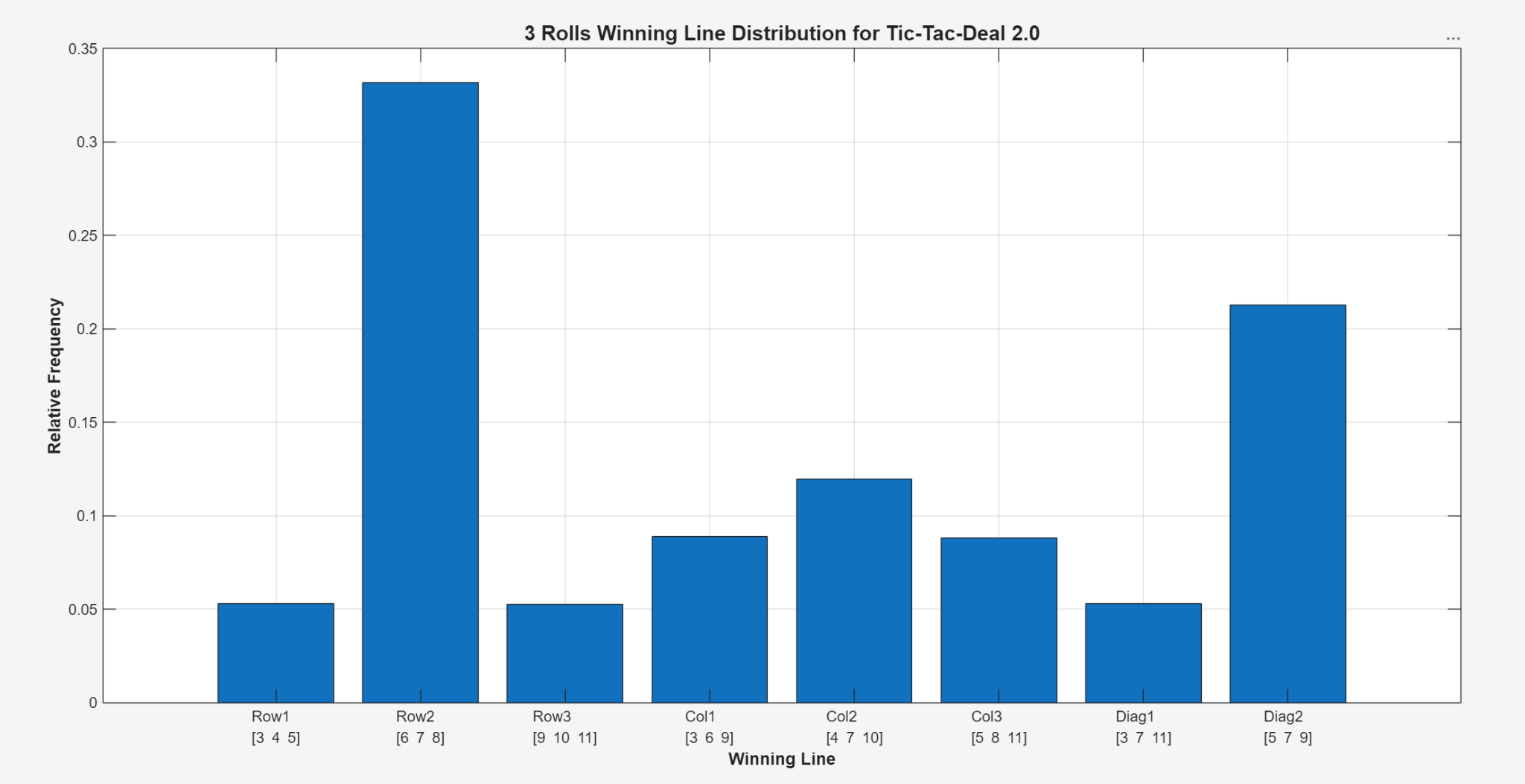
Summing these eight probabilities gave you 113/1944, or about 5.81 percent, which was the answer to the puzzle. Alas, you were not very likely to win this game with just three rolls.
Last Week’s Extra Credit
Congratulations to the (randomly selected) winner from last week: 🎻 Lise Andreasen 🎻 from Valby, København, Danmark. I received 44 timely submissions, of which 36 were correct—good for an 82 percent solve rate.
In the actual game, you got five rolls instead of three. But as before, rolling a 2, a 12, or a number that you already rolled was a wasted turn.
With five rolls of the dice, what were your chances of getting three Xs in a row, either horizontally, vertically, or diagonally?
