
Let’s Make a Tic-Tac-Deal!
In a modified version of tic-tac-toe, the nine squares are represented by the numbers 3 through 11. How likely are you to win by rolling a pair of dice?

Welcome to Fiddler on the Proof, the spiritual successor to FiveThirtyEight’s The Riddler column.
Every Friday morning, I present mathematical puzzles intended to challenge and delight you. Most can be solved with careful thought, pencil and paper, and the aid of a calculator. The “Extra Credit” is where the analysis typically gets hairy, or where you might turn to a computer for assistance.
I’ll also give a shoutout to 🎻 one lucky winner 🎻 of the previous week’s puzzle, chosen randomly from among those who submit their solution before 11:59 p.m. the Monday after puzzles are released. I’ll do my best to read through all the submissions and give additional shoutouts to creative approaches or awesome visualizations, the latter of which could receive 🎬 Best Picture Awards 🎬.
This Week’s Fiddler
From Nicholas Smith comes a puzzle about a modified version of tic-tac-toe:
The game of Tic-Tac-Deal 2.0 has a 3-by-3 square grid with the numbers 3 through 11, arranged as follows:
3 4 5
6 7 8
9 10 11
You start by rolling a standard pair of six-sided dice and add the two numbers rolled. You place an X on the board on the square that contains the sum. If the sum is a 2 or 12, or if you roll a sum that you have previously rolled, then your roll is wasted.
If you have exactly three rolls of the dice, what are your chances of getting three Xs in a row (either horizontally, vertically, or diagonally)?
This Week’s Extra Credit
In the actual game, you get five rolls instead of three. But as before, rolling a 2, a 12, or a number that you have already rolled is a wasted turn.
With five rolls of the dice, what are your chances of getting three Xs in a row, either horizontally, vertically, or diagonally?
Making the ⌊Rounds⌉
There’s so much more puzzling goodness out there, I’d be remiss if I didn’t share some of it here. This has been quite a week for math and science prizes, with the Nobel Prize in Physics awarded for observable quantum effects and a MacArthur Fellowship for Lauren K. Williams that recognizes her work in algebraic combinatorics.
Something else that caught my attention (courtesy of Benjamin Dickman) was a neat question asked and answered over on MathOverflow, which I’ll paraphrase here:
Consider the sequence Ln = LCM(1, 2, 3, …, n) and the sequence HA of highly abundant numbers, which are numbers for whose divisors (including itself) add up to a greater value than for any smaller numbers. Is every number in the sequence Ln highly abundant?
The answer, courtesy of one Terry Tao, is in the comments over on MathOverflow.
Want to Submit a Puzzle Idea?
Then do it! Your puzzle could be the highlight of everyone’s weekend. If you have a puzzle idea, shoot me an email. I love it when ideas also come with solutions, but that’s not a requirement.
Standings
I’m tracking submissions from paid subscribers and compiling a leaderboard, which I’ll reset every quarter. All correct solutions to Fiddlers and Extra Credits are worth 1 point each. Solutions should be sent prior to 11:59 p.m. the Monday after puzzles are released. At the end of each quarter, I’ll 👑 crown 👑 the finest of Fiddlers. If you think you see a mistake in the standings, kindly let me know.
ChatGPT-5 Reasoning initially missed last week’s Fiddler but solved the Extra Credit. At that point, I asked it to reattempt the Fiddler, which it then answered correctly. But only first attempts count! Sorry, I don’t make up the rules. Oh wait, I do.
Last Week’s Fiddler
Congratulations to the (randomly selected) winner from last week: 🎻 Dean Ballard 🎻 from Seattle, Washington. I received 40 timely submissions, of which 38 were correct—good for a 95 percent solve rate.
Last week, Anita the ant was going for a walk in the sand, leaving a trail as she went. First, she walked 1 inch in a straight line. Then she rotated counterclockwise by an angle 𝝋, after which she walked another 2 inches. She rotated counterclockwise an angle 𝝋 again, after which she walked 3 inches. She kept doing this over and over again, rotating counterclockwise an angle 𝝋 and then walking 1 inch farther than she did in the previous segment.
At some point during her journey, she crossed over her initial 1-inch segment. By “cross over,” I am including the two end points of that first segment.
Anita realized that 𝝋 was the smallest possible angle such that she crossed over her 1-inch segment. (Among the ants, she’s known for her mathematical prowess.)
How long was the segment along which she first crossed over the 1-inch segment? Your answer was some whole number of inches.
For Anita to cross the 1-inch segment while on her 2-inch segment, she would have had to turn straight back around, meaning she turned 𝜋 radians, or 180 degrees. Great! But surely it was possible for her to cross the 1-inch segment by turning some angle less than 180 degrees, right?
If that was true, then she couldn’t have crossed it on the 3-inch segment. Why? Because the 2- and 3-inch segments would then have had to form a triangle with part of the 1-inch segment, and you can’t make a triangle with side lengths of 2 and 3 along with a third side of length less than or equal to 1. That would violate the triangle inequality!
As long as 𝝋 was less than 180 degrees, the first time Anita could have crossed her 1-inch segment was along her 4-inch segment. Let’s see if that checks out by starting with small values of 𝝋 and ratcheting it up.
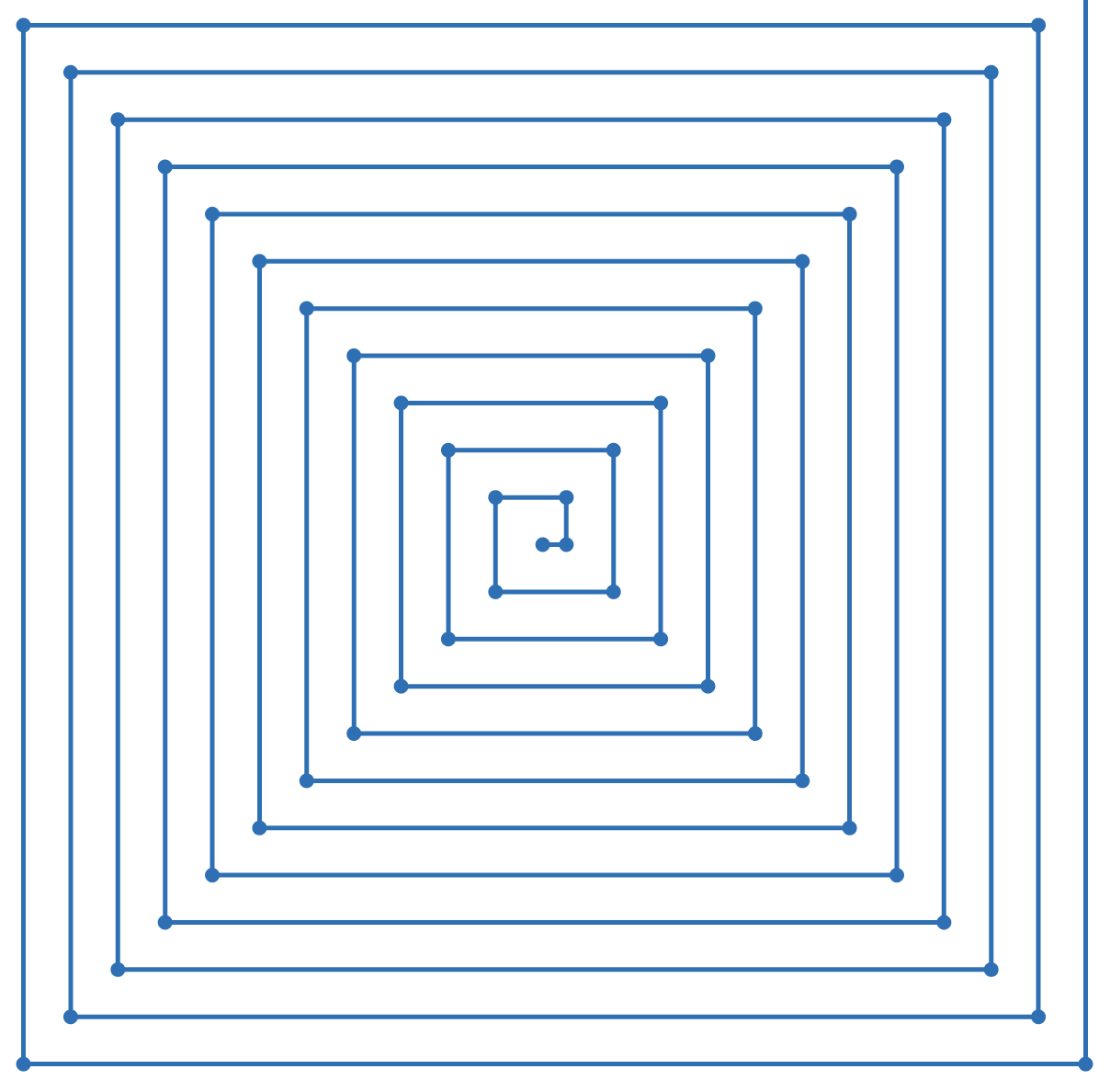
For small angles, Anita wound up spiraling around in a long arc. As 𝝋 increased, this spiraling became tighter and tighter. For certain values of 𝝋, Anita’s path never crossed over itself at all! For example, when 𝝋 was 𝜋/2 radians (or 90 degrees), Anita traversed a square spiral:
And when 𝝋 was 2𝜋/3 radians (or 120 degrees), her path was a triangular spiral:

But for other values of 𝝋, the path did indeed cross over itself. For smaller values of 𝝋, the first such crossing occurred many segments into the path. But as 𝝋 increased, the first crossing happened for shorter and shorter segments.
Eventually, her path crossed over her first segment, as demonstrated via animations from solvers like 🎬 Tom Keith 🎬 and 🎬 Michael Schubmehl 🎬. Here was Michael’s video, which shows some wild patterns, especially as 𝝋 passes through values of 2𝜋/N for integers N. The animation changes from black to red once Anita’s 1-inch segment is crossed.
Here’s a static image showing when Anita first crosses over her 1-inch segment:
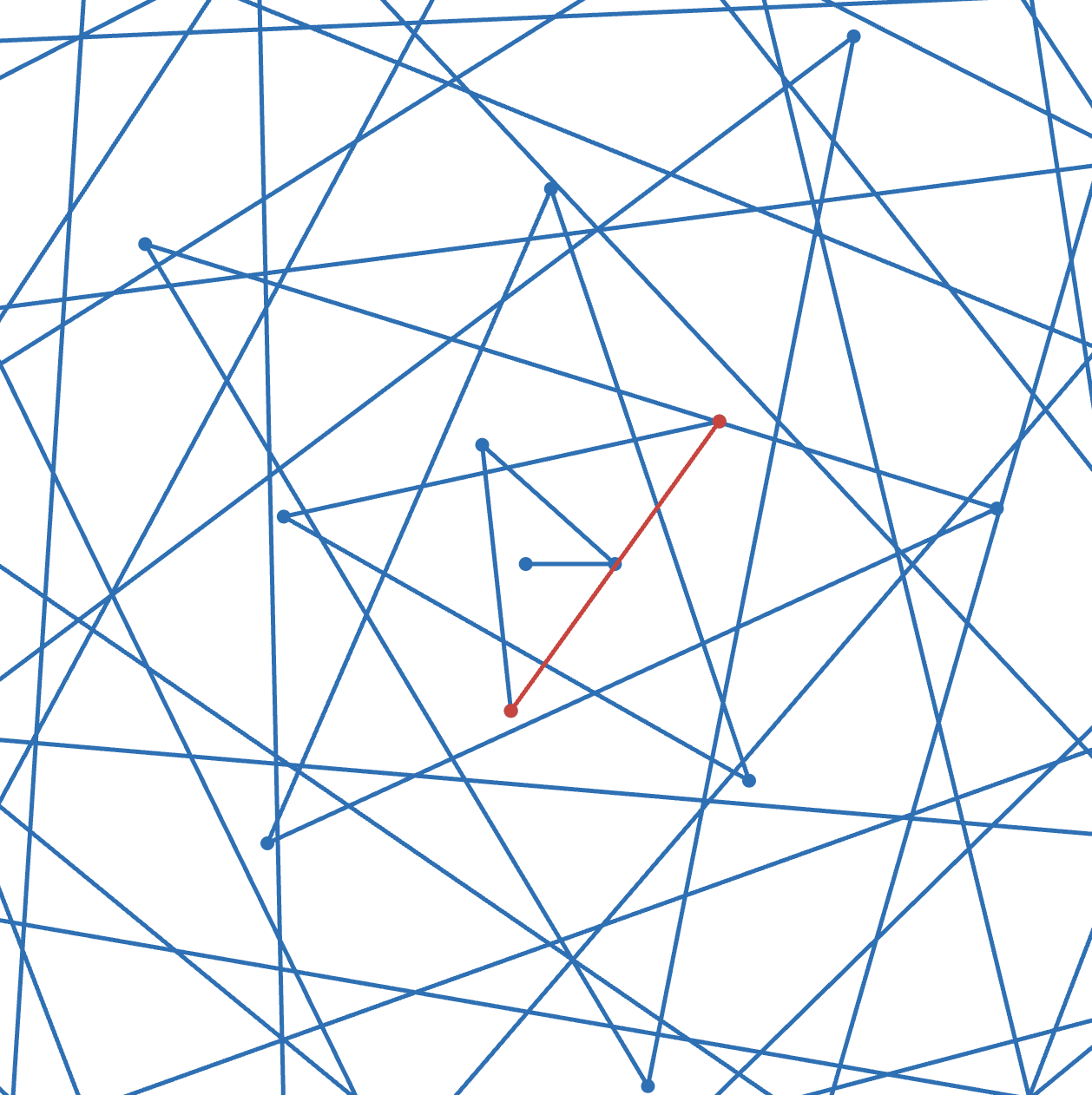
This crossing happened on Anita’s fourth segment (shown in red above). Thus, 4 inches was the answer to last week’s puzzle. (If you answered 10 inches and did so because you summed the lengths of the first four segments, I still awarded credit.)
But what was the mysterious value of 𝝋 that led to this crossing? That was a matter for the Extra Credit.
Last Week’s Extra Credit
Congratulations to the (randomly selected) winner from last week: 🎻 Thomas Stone 🎻 from San Francisco, California. I received 38 timely submissions, of which 37 were correct—good for a 97 percent solve rate
For Extra Credit, you had to check Anita’s work. What was the measure of angle 𝝋?
