
Can You Number the Number Cubes?
You write a digit on each face of four number cubes. Using three cubes at a time, and starting from “001,” how high can you count?

Welcome to Fiddler on the Proof, the spiritual successor to FiveThirtyEight’s The Riddler column.
Every Friday morning, I present mathematical puzzles intended to challenge and delight you. Most can be solved with careful thought, pencil and paper, and the aid of a calculator. The “Extra Credit” is where the analysis typically gets hairy, or where you might turn to a computer for assistance.
I’ll also give a shoutout to 🎻 one lucky winner 🎻 of the previous week’s puzzle, chosen randomly from among those who submit their solution before 11:59 p.m. the Monday after puzzles are released. I’ll do my best to read through all the submissions and give additional shoutouts to creative approaches or awesome visualizations, the latter of which could receive 🎬 Best Picture Awards 🎬.
This Week’s Fiddler
From John Torrey comes a puzzle any sufficiently clever Bond villain would appreciate:
You have four number cubes, where each face of each cube can display one numeric digit from 0 to 9. You can make various numbers by picking three faces on three distinct cubes and lining them up. For example, you can make the number “123” by lining up three cubes to show 1-2-3, and you can make the number “7” by lining up three cubes to show 0-0-7.
Importantly, any face with a “6” can also be used to display a “9” by flipping the cube around, and vice versa. However, no other pairs of digits are interchangeable in this way.
You can choose which digits to place on the various faces of the four cubes. Your goal is to be able to make all the whole numbers from 1 to N, without skipping any numbers in between. With optimal design, what is the greatest possible value of N?
This Week’s Extra Credit
From John Torrey also comes some Extra Credit:
How many distinct ways can you assign numbers to the four cubes that result in this greatest possible value of N?
Note that the cubes are not ordered in any way. And, very importantly, swapping digits between two faces on a single cube does not count as producing a distinct arrangement. In other words, don’t worry about the various ways to assign six given digits to the faces of a cube. (Also, “6” and “9” count as the same digit here.")
Making the ⌊Rounds⌉
There’s so much more puzzling goodness out there, I’d be remiss if I didn’t share some of it here. This week, I’m sharing (for the last time, I promise) my March Madness predictions.
As a quick reminder, my methodology involved (1) ranking teams via regression using all the thousands of games in the season and (2) only advancing underdogs when their output from the regression was within some distance of the favorite’s.
My predictions did really well this year. Yes, I got lucky, but I was within a second (looking at you, Duke vs. UConn) of correctly identifying all eight Final Four teams across the men’s and women’s tournaments. I also correctly predicted both the men’s and women’s champions.
I’ll definitely have a similar post next year, but past results do not guarantee future performance.
Want to Submit a Puzzle Idea?
Then do it! Your puzzle could be the highlight of everyone’s weekend. If you have a puzzle idea, shoot me an email. I love it when ideas also come with solutions, but that’s not a requirement.
Standings
I’m tracking submissions from paid subscribers and compiling a leaderboard, which I’ll reset every quarter. All correct solutions to Fiddlers and Extra Credits are worth 1 point each. Solutions should be sent prior to 11:59 p.m. the Monday after puzzles are released. At the end of each quarter, I’ll 👑 crown 👑 the finest of Fiddlers. If you think you see a mistake in the standings, kindly let me know.
Last Week’s Fiddler
Congratulations to the (randomly selected) winner from last week: 🎻 Jim R 🎻 from Cambridge. I received 39 timely submissions, of which 30 were correct—good for a 77 percent solve rate.
Last week, an alien—more specifically, an Eridian—named “Rocky” had to pass a solid xenonite crystal to his human friend in a neighboring spaceship. The crystal was shaped like a regular tetrahedron, as shown below, and all its edges had length 1.
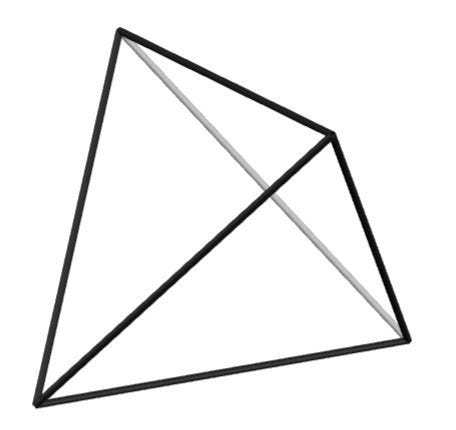
To safely transport the crystal, Rocky created a long, cylindrical tunnel between the spaceships, and then oriented the tetrahedron so that it fit through the tunnel. (It was okay if the crystal fit snugly inside the tunnel—in this case, it could slide along without any friction.)
What was the minimum possible radius for the tunnel so that the crystal fit through it?
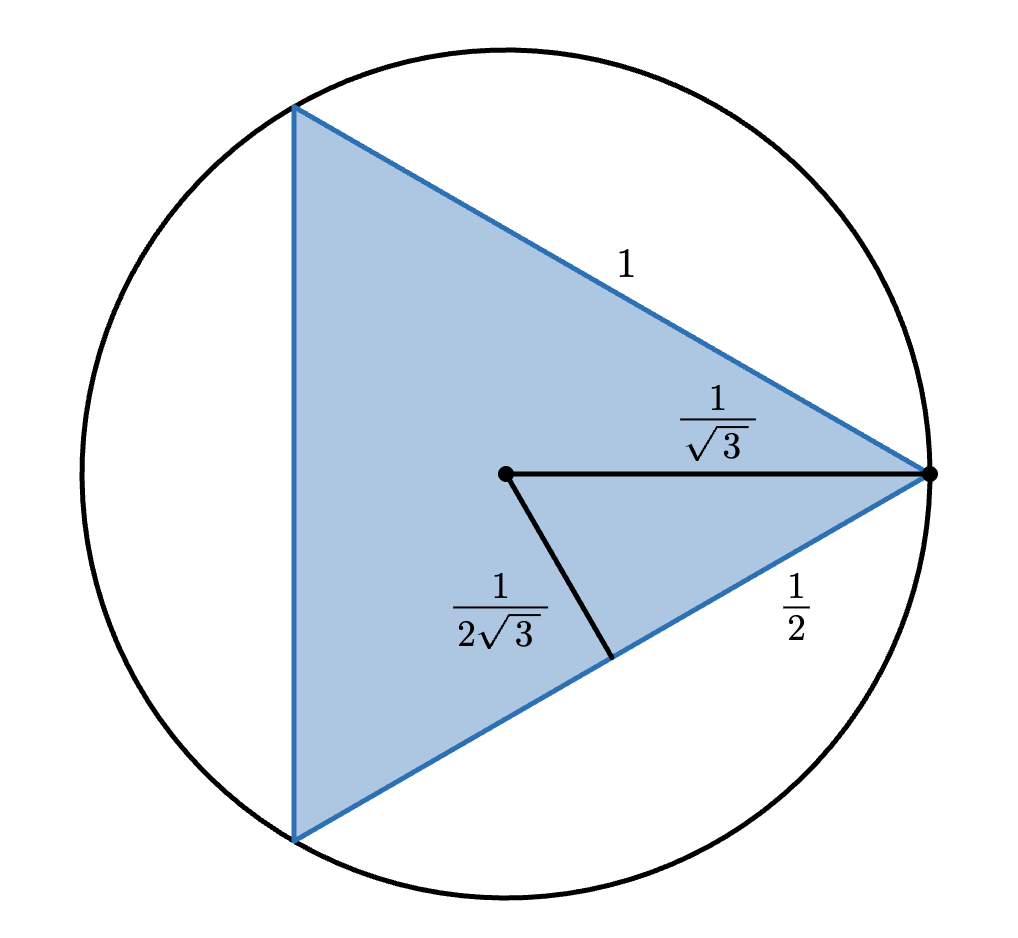
At first, it might have been tempting to push the tetrahedron down the tunnel with one of its four triangular faces leading the way. This meant the circle needed to circumscribe an equilateral triangle with side length 1. As shown in the diagram below, such a circle had a radius of 1/√3, or approximately 0.57735.
But Rocky could do even better. Instead of sliding the tetrahedron face-first down the tube, he could slide one of its edges along so it scraped the side of the tube, as shown below:
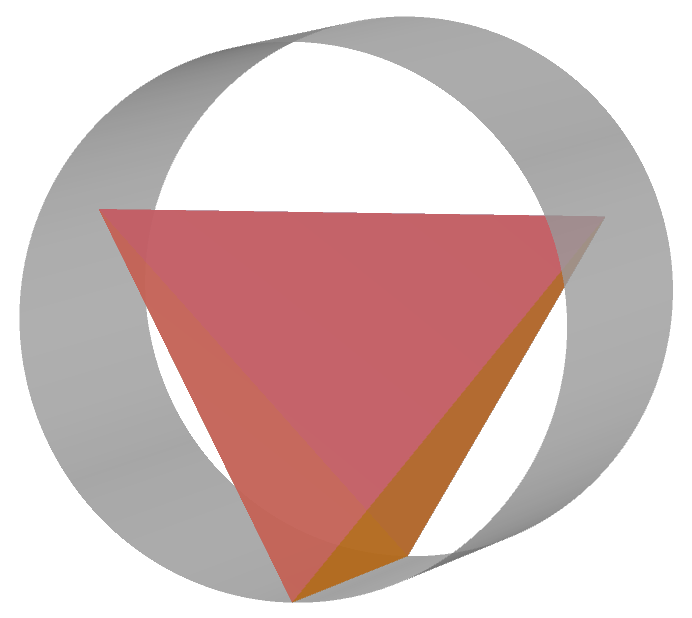
In this orientation, the tube wasn’t circumscribing an equilateral triangle, but rather the projection of a tilted equilateral triangle. With some 3D trigonometry, the radius of the tube worked out to be 3/(4√2), or approximately 0.53033. That was quite the improvement!
But Rocky could still do better. The image below shows how the tetrahedron could have been squeezed into an even narrower cylinder. One of its edges ran diametrically across the tube, while the opposite edge (i.e., the one between the remaining two vertices of the tetrahedron) also ran diametrically across the tube, but in the perpendicular direction.
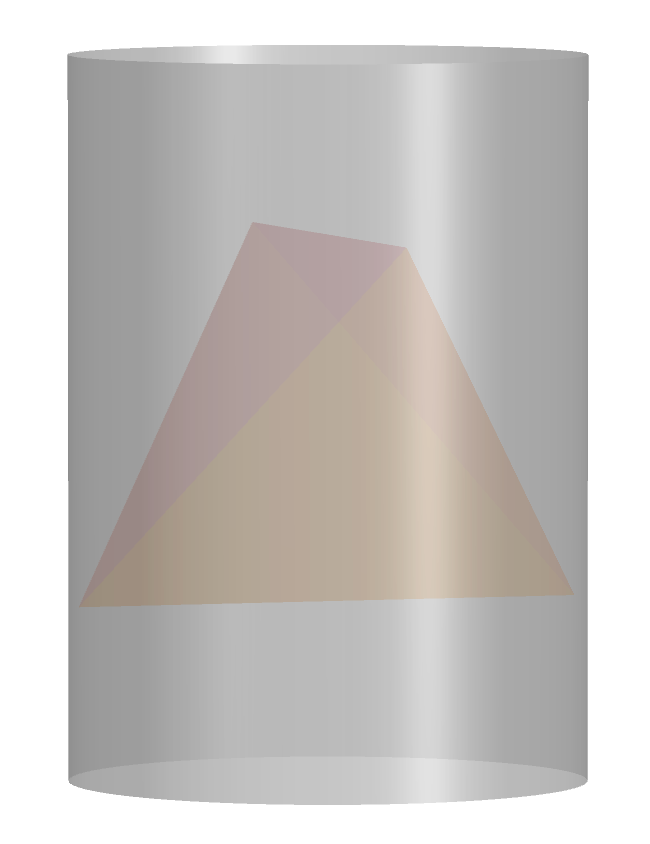
Here’s what this would have looked like from Rocky’s perspective, peering down the tube:
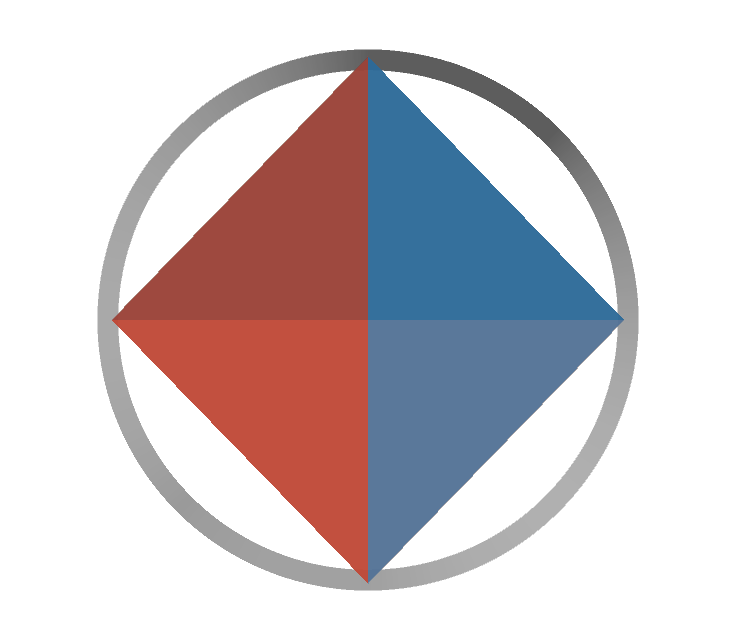
Thus, the tube had to circumscribe a square with a diagonal of length 1, which meant the tube required a radius of 1/2, or 0.5. (If you mistakenly submitted the diameter instead of the radius, I still awarded credit.)
As a check, solver 🎬 Michael Schubmehl 🎬 looked at all possible orientations and determined what the resulting cylindrical radius would be for each. The orientations were parameterized by subsequent rotations about the z-axis (also the assumed axis of the cylinder) and then about the x-axis, where rotations of zero corresponded to the optimal solution above. Here are his results:
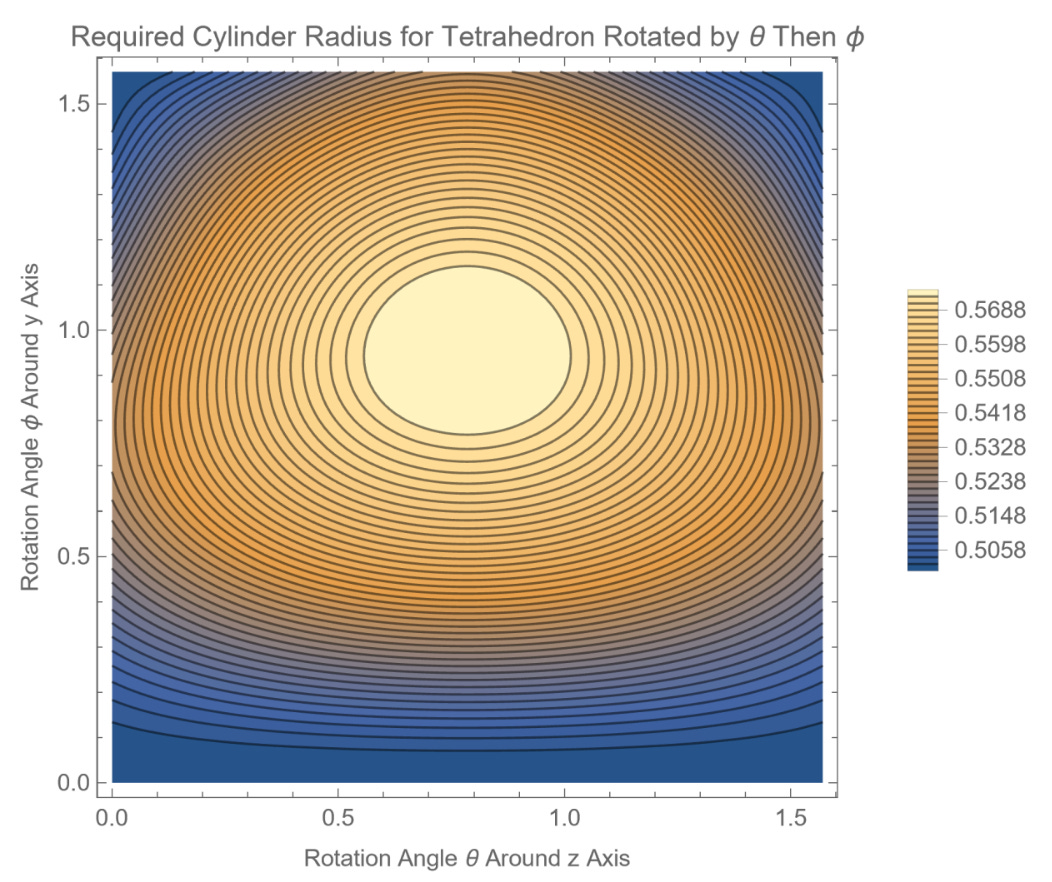
Sure enough, the cylinder couldn’t get any tighter than a radius of 0.5. What’s more, the radius of 1/√3 we found initially corresponded to the least efficient orientation for the tetrahedron!
Last Week’s Extra Credit
Congratulations to the (randomly selected) winner from last week: 🎻 Pierre Bierre 🎻 from Pleasanton, California. I received 23 timely submissions, of which 20 were correct—good for an 87 percent solve rate.
Next, Rocky wanted to transport a solid crystal shaped like a regular dodecahedron to his human friend. As before, each edge had length 1.

This time, the long tunnel between the space ships could have been any right prismatic shape, not necessarily a cylinder. Once again, Rocky needed the crystal to fit through the tunnel, and it was okay if that fit was snug.
What was the minimum possible cross-sectional area for the tunnel so that the crystal fit through it?
