
Can You Catch the Longest Wave?
A big wave makes landfall on a semicircular island and leaves the island 10 minutes later. What stretch of land might it cover 5 minutes after landfall?

Welcome to Fiddler on the Proof, the spiritual successor to FiveThirtyEight’s The Riddler column.
Every Friday morning, I present mathematical puzzles intended to challenge and delight you. Most can be solved with careful thought, pencil and paper, and the aid of a calculator. The “Extra Credit” is where the analysis typically gets hairy, or where you might turn to a computer for assistance.
I’ll also give a shoutout to 🎻 one lucky winner 🎻 of the previous week’s puzzle, chosen randomly from among those who submit their solution before 11:59 p.m. the Monday after puzzles are released. I’ll do my best to read through all the submissions and give additional shoutouts to creative approaches or awesome visualizations, the latter of which could receive 🎬 Best Picture Awards 🎬.
This Week’s Fiddler
Semicircle Island is shaped like a perfect semicircle (or semidisk, technically), with a radius of 1 mile. It doesn’t have any permanent residents, but it’s a very popular destination for surfers.
Rumor has it that a big wave is headed toward the island, but no one knows which direction it’s coming from. This thin, straight wall of water never changes speed or direction. It will first make contact with the island at 10 a.m. and it will last be in contact with the island at 10:10 a.m.
What is the longest possible stretch of land that is directly under the wave at 10:05 a.m.?
This Week’s Extra Credit
Another wave is approaching the island, but again no one knows which direction it’s coming from—for the moment, all directions are equally likely. For example, it might come in the direction illustrated below:
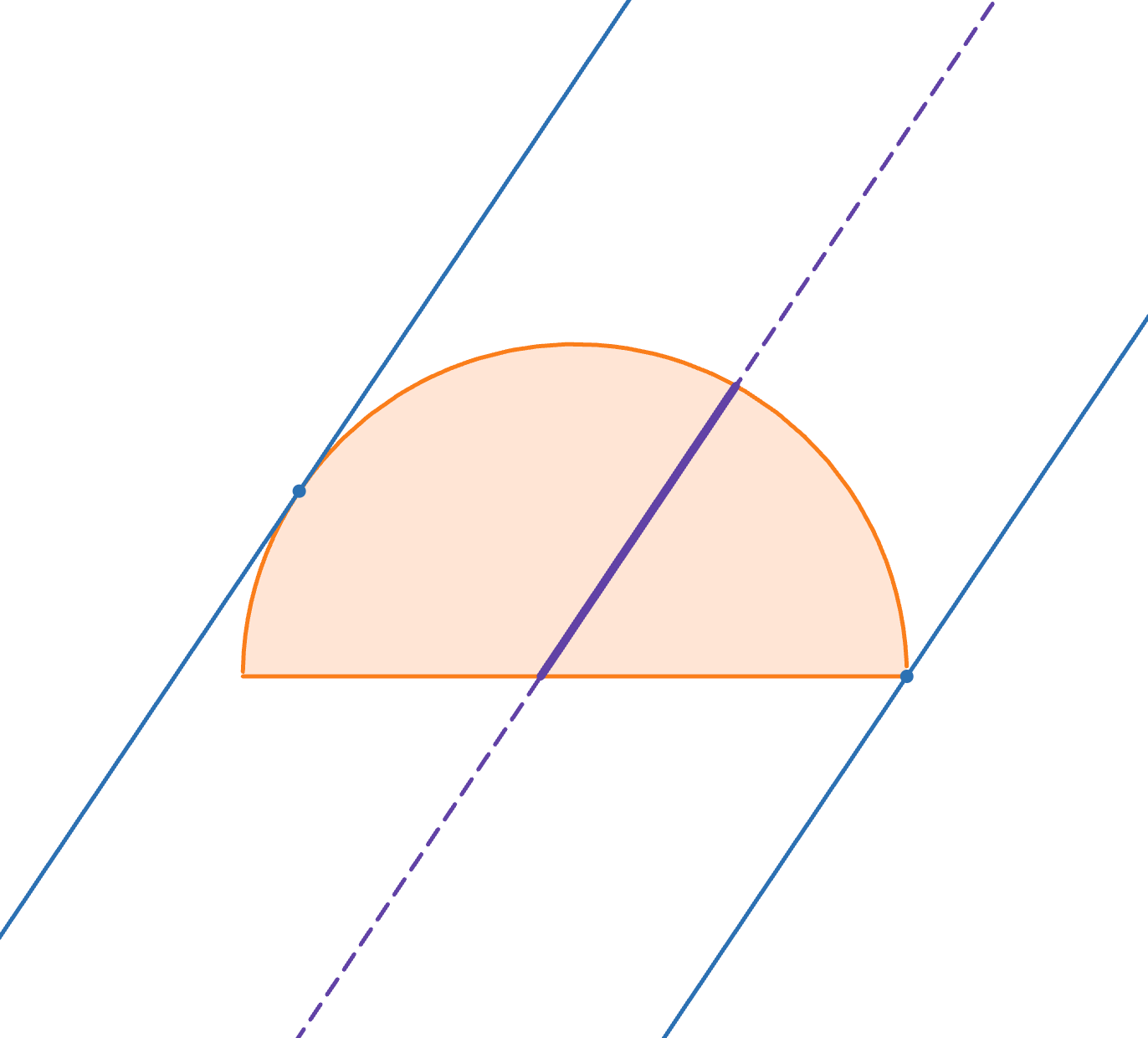
On average, what is the length of the stretch of land directly under the wave halfway between when the wave first and last makes contact with the island?
Making the ⌊Rounds⌉
There’s so much more puzzling goodness out there, I’d be remiss if I didn’t share some of it here. This week, I’m late to the party in sharing that a significant Erdős problem has been solved by AI. This one concerns unit distances:
Suppose you have N points in the plane. As N grows very, very large, how many pairs of points can you possibly have that are a unit distance apart? With a gridlike arrangement of points, the number of such pairs grows linearly with N. But the AI proved that a superlinear function of the form N1+𝛿 (for some constant 𝛿 > 0) was in fact a lower bound. Wow.
By the way, this reminds me of another nugget involving unit distances:
Suppose every point in the plane is colored red, green, or blue. Find seven points in the plane such that, no matter how the points are colored, you will always have two points among the seven that are the same color and are a unit distance apart.
Want to Submit a Puzzle Idea?
Then do it! Your puzzle could be the highlight of everyone’s weekend. If you have a puzzle idea, shoot me an email. I love it when ideas also come with solutions, but that’s not a requirement.
Standings
I’m tracking submissions from paid subscribers and compiling a leaderboard, which I’ll reset every quarter. All correct solutions to Fiddlers and Extra Credits are worth 1 point each. Solutions should be sent prior to 11:59 p.m. the Monday after puzzles are released. At the end of each quarter, I’ll 👑 crown 👑 the finest of Fiddlers. If you think you see a mistake in the standings, kindly let me know.
Last Week’s Fiddler
Congratulations to the (randomly selected) winner from last week: 🎻 Alastair 🎻 from Cape Town, South Africa. I received 75 timely submissions, of which 73 were correct—good for a 97 percent solve rate.
Last week, three game show contestants had to work together to win a prize. They were shown a large bag that was initially empty, and then they saw three red hats and two white hats placed into the bag. At this point, the contestants were blindfolded. Each contestant then picked a hat at random from the bag and placed it on their head.
One at a time, their blindfolds were removed and they could see the hats on the others’ heads—but not the hat on their own head. If they could, with absolute certainty, identify the color of the hat on their own head, then the game was over and all three contestants won a prize! Otherwise, they skipped their turn, at which point the next contestant had their blindfold removed and the process continued. If all three contestants skipped their turn, then no prize was won. While blindfolded, contestants could still hear the decisions of other contestants and could identify who said what.
Did the contestants always win the prize?
Let’s approach this logically, by considering the contestants in order of blindfold removal. We’ll use “R” to mean a corresponding contestant had a red hat and “W” for white hat. There were eight potential cases to consider:
RRR
RRW
RWR
WRR
RWW
WRW
WWR
WWW
Since there were only two white hats in the bag, we could eliminate that last case right off the bat. So now we were down to seven cases:
RRR
RRW
RWR
WRR
RWW
WRW
WWR
Now imagine you were the first contestant looking at the other two hats. If you saw two white hats, you knew your hat was red. That’s because there were only two white hats, and equivalently because the case “RWW” was unique among the remaining cases in that ended with “WW.”
If that’s what the first contestant actually saw, then great! Otherwise, the first contestant wasn’t sure about their hat, and the game continued as one of the following six cases:
RRR
RRW
RWR
WRR
WRW
WWR
Now imagine you were the second contestant looking at the other two hats. As before, if you saw two white hats, you knew your hat was red. And again, one way to explain that was that “WRW” was the only remaining case that began and ended with a “W.”
But wait—there was another case with a unique beginning and end: “RRW.” If the second contestant saw a red hat on the first contestant’s head and a white hat on the third contestant’s head, they knew their own hat had to be red! Why? Suppose the second contestant had a white hat on. Then the first contestant would have seen two white hats and realized their own hat was red. But since the first contestant said nothing, this case could be eliminated.
So if the second contestant was able to identify their hat color, then great! Otherwise, the second contestant wasn’t sure about their hat, and the game continued as one of the following four cases:
RRR
RWR
WRR
WWR
Whenever the game reached the third contestant, their hat was guaranteed to be red. Thus, the contestants always won the prize. Interestingly, they always locked in their win when one of the contestants realized their hat was red, and never when it was white.
Last Week’s Extra Credit
Congratulations to the (randomly selected) winner from last week: 🎻 Aaron P. Moskalik 🎻 from Southfield, Michigan. I received 33 timely submissions, of which 30 were correct—good for a 91 percent solve rate.
Now, there were four game show contestants who had to work together. They were shown a large bag that was initially empty, and then they saw R red hats, W white hats, and B blue hats placed into the bag such that R, W, and B were each less than or equal to 4. Otherwise, the game was played as before.
For some triples (R, W, B), the contestants always won. Among these, what was the greatest value of R + W + B?
