
When Will You Cross Your Path?
An ant crawls straight ahead for 1 inch, then turns, crawls straight ahead for 2 inches, then turns the same amount, and so on. When can it first cross the initial segment?

Welcome to Fiddler on the Proof! The Fiddler is the spiritual successor to FiveThirtyEight’s The Riddler column, which ran for eight years under the stewardship of myself and Ollie Roeder.
Each week, I present mathematical puzzles intended to both challenge and delight you. Puzzles come out Friday mornings (8 a.m. Eastern time). Most can be solved with careful thought, pencil and paper, and the aid of a calculator. The “Extra Credit” is where the analysis typically gets hairy, or where you might turn to a computer for assistance.
I’ll also give a shoutout to 🎻 one lucky winner 🎻 of the previous week’s puzzle, chosen randomly from among those who submit their solution before 11:59 p.m. the Monday after that puzzle was released. I’ll do my best to read through all the submissions and give additional shoutouts to creative approaches or awesome visualizations, the latter of which could receive 🎬 Best Picture Awards 🎬.
This Week’s Fiddler
Anita the ant is going for a walk in the sand, leaving a trail as she goes. First, she walks 1 inch in a straight line. Then she rotates counterclockwise by an angle 𝝋, after which she walks another 2 inches. She rotates counterclockwise an angle 𝝋 again, after which she walks 3 inches. She keeps doing this over and over again, rotating counterclockwise an angle 𝝋 and then walking 1 inch farther than she did in the previous segment.
At some point during her journey, she crosses over her initial 1-inch segment. By “cross over,” I am including the two end points of that first segment.
Anita realizes that 𝝋 was the smallest possible angle such that she crossed over her 1-inch segment. (Among the ants, she’s known for her mathematical prowess.)
How long was the segment along which she first crossed over the 1-inch segment? Your answer should be a whole number of inches.
This Week’s Extra Credit
It’s time for you to check Anita’s work. What was the measure of angle 𝝋?
Remember, this was the smallest possible angle for each turn such that she crossed over her 1-inch segment at some later point.
Making the ⌊Rounds⌉
There’s so much more puzzling goodness out there, I’d be remiss if I didn’t share some of it here. This week, I’m sharing an interesting feature from The New York Times, “Barcelona Is Made of Math.”
I expected an article about unconventional mathematics used in Spanish architecture. Instead, it was a series of introductory math problems inspired by buildings in Barcelona. So … not what I was expecting, but still kind of cute? If you have a family member who’s into architecture but not (yet) into math, this article may be worth sharing.
Want to Submit a Puzzle Idea?
Then do it! Your puzzle could be the highlight of everyone’s weekend. If you have a puzzle idea, shoot me an email. I love it when ideas also come with solutions, but that’s not a requirement.
Standings
I’m tracking submissions from paid subscribers and compiling a leaderboard, which I’ll reset every quarter. All timely correct solutions to Fiddlers and Extra Credits are worth 1 point each.
The results from Q3 are in, and the finest of Fiddlers, who each solved all 24 puzzles, are:
👑 Josh Arnold 👑 from Arlington, Massachusetts
👑 Michael Schubmehl 👑 from Hinsdale, Illinois
👑 Peter Ji 👑 from Madison, Wisconsin
Congratulations to all who participated; the final standings are below. (If you think you see a mistake in the standings, kindly let me know.)
While ChatGPT-5 Reasoning did very well, correctly solving 21 of the 24 puzzles on its first attempt, it didn’t get everything right. We’ll see how it does in Q4.
I will be reaching out to the top finishers so I can send along a fancy-schmancy t-shirt prize!
Also, this week’s puzzles mark the beginning of the next quarter (Q4). If you’d like your shot at glory (and a t-shirt), become a paid subscriber today!
Last Week’s Fiddler
Congratulations to the (randomly selected) winner from last week: 🎻 Rich Erikson 🎻 from Warrenton, Virginia. I received 78 timely submissions, of which 69 were correct—good for an 88 percent solve rate.
Last week, I was playing the board game Risk with one of my kids. At the end of each turn in the game in which I conquered at least one enemy territory on the board, I was dealt a card.
There were 42 territory cards in the deck—14 that depicted an infantry unit, 14 that depicted a cavalry unit, and 14 that depicted an artillery unit. Once I had three cards that either (1) all depicted the same kind of unit, or (2) all depicted different kinds of units, I could trade them in at the beginning of my next turn in exchange for some bonus units to be placed on the board.
If I was randomly dealt three cards from the 42, what was the probability that I could trade them in?
Let’s put aside the numbers 14 and 42 for a moment. Suppose the deck had many, many cards, and the probability of each card type (infantry, cavalry, and artillery) was 1/3. If you were dealt two cards, then no matter what these two cards were, only one type of card could have completed your tradable set. That’s because if your first two cards were the same, you needed that same type for your third card; if the first two cards were different, you needed the third type. Thus, the probability of being dealt a tradable set with just three cards when there were many, many cards in the deck was 1/3.
Of course, the deck in the puzzle was finite rather than infinite, which made a difference. In an infinitely large deck, you could assume that each card’s type was independent of the others. But that wasn’t the case in a finite deck. For example, if the first card you drew was an infantry card, the next card was less likely to be an infantry card because one had now been removed from the deck; instead, the next card was more likely to be a cavalry or artillery card.
An extreme case would have been if there was only one card of each type in the deck. The probability of getting a tradable set with (all) three cards was 100 percent!
Next, suppose there were two cards of each type in the deck. The only way to get a tradable set was if all three cards were of different types, since the deck didn’t contain three cards of any single type. Suppose you drew your first card, which was one of the three types—let’s say it was X. You needed the second card to be one of the other types, which had probability 4/5, since the deck had one X, two Ys, and two Zs. Suppose the second card was a Y. Finally, you needed the third card to be a Z, which had probability 1/2, since the deck now had one X, one Y, and two Zs. The probability of all this happening was (4/5)·(1/2), which simplified to 2/5 or 40 percent.
As the number of cards increased, your chances of being dealt a tradable set among the first three cards presumably approached 1/3 (the result from having an infinite deck). Instead of tackling a 42-card deck, let’s solve the general case when there were N cards of each type, for a total deck with 3N cards. Once we have this general solution, we can plug in N = 14 to get the answer to the puzzle.
First, let’s find the probability of getting a set with three cards of the same type. After you were dealt the first card, there were 3N−1 cards left in the deck, N−1 of which were the same type as that first card. Thus, the probability the second card was of the same type was (N−1)/(3N−1). Similarly, the probability the third card was also of the same type as the first two was (N−2)/(3N−2). Multiplying these together, the probability of getting three cards of the same type was (N−1)·(N−2)/[(3N−1)·(3N−2)], or (N2−3N+2)/(9N2−9N+2).
Next, let’s find the probability of getting a set with three different types. After you were dealt the first card, there were 2N cards among the remaining 3N−1 that didn’t match the first. And after that, there were N cards among the remaining 3N−2 that didn’t match the first or second. Putting these together, the probability was (2N)·(N)/[(3N−1)·(3N−2)], or (2N2)/(9N2−9N+2).
Combining these cases, the total probability of being dealt a tradable set of three cards was (N2−3N+2)/(9N2−9N+2) + (2N2)/(9N2−9N+2), which simplified to (3N2−3N+2)/(9N2−9N+2). This rational function is plotted in the graph below. Note how it returned the correct probabilities even when N was 1 or 2, and how it rapidly approached 1/3 (indicated by the dashed line).
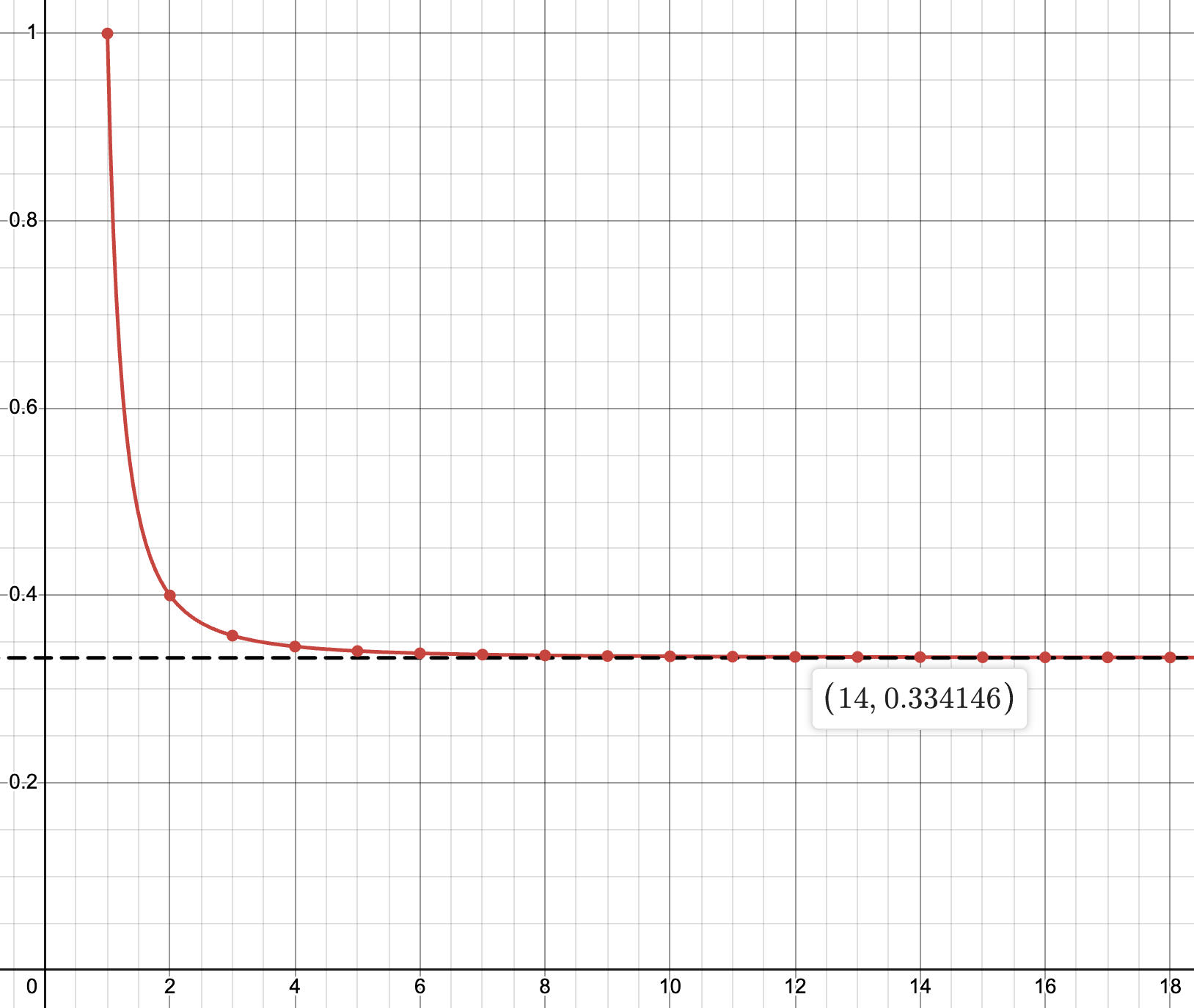
Plugging in N = 14 returned a result of 137/410, or approximately 33.4 percent, which was the answer to last week’s puzzle. Indeed, that was very nearly 1/3!
Last Week’s Extra Credit
Congratulations to the (randomly selected) winner from last week: 🎻 Aaron Wolfson 🎻 from Troy, Michigan. I received 49 timely submissions, of which 41 were correct—good for an 84 percent solve rate.
The full deck of Risk cards also contained two wildcards, which could be used as any of the three types of cards (infantry, cavalry, and artillery) upon trading them in. Thus, the full deck consisted of 44 cards.
If I was randomly dealt cards from a complete deck of 44 one at a time, how many cards would I have needed, on average, until I could trade in three?
